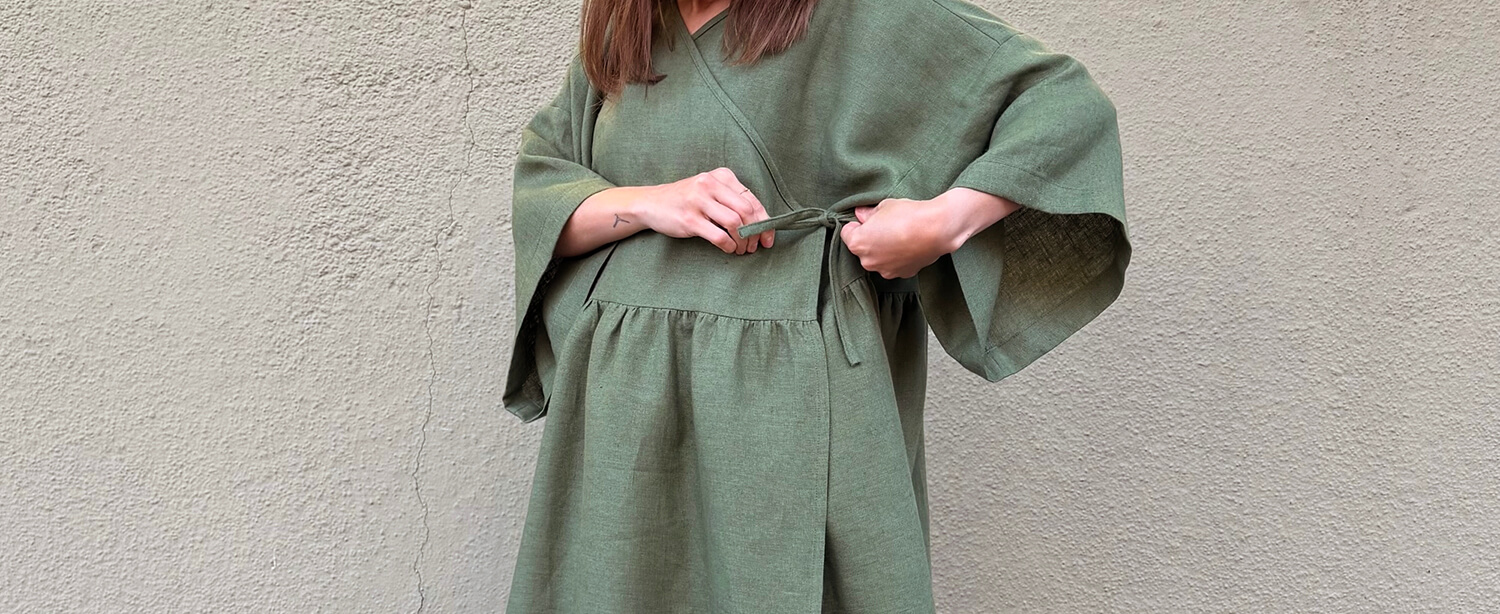
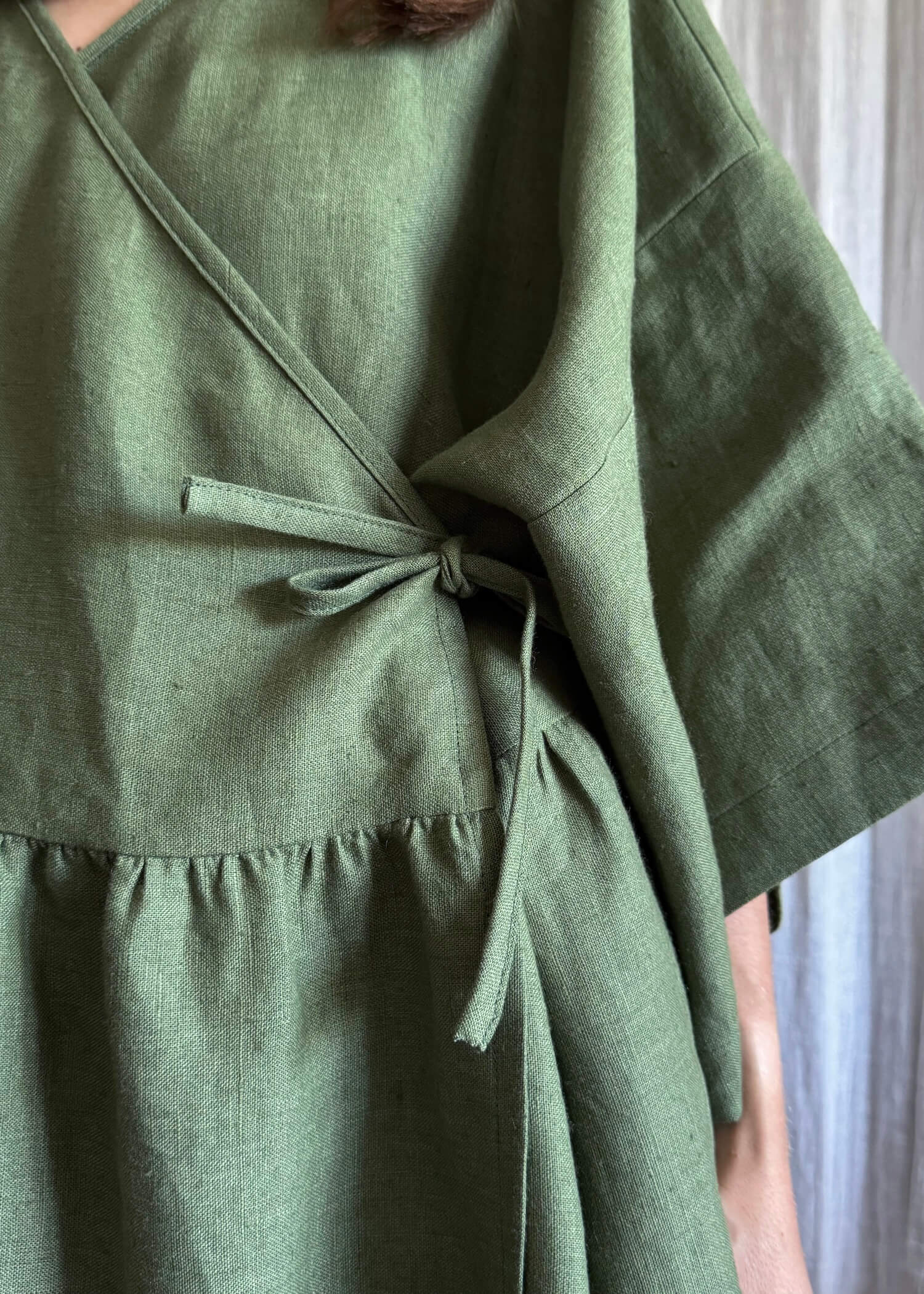
Indigo Indogo Helios Dress made with FS Dried Herb Midweight linen
Could you tell us a bit about yourself and how you got into sewing?
Heya! My name is Emma Cartmel, and I am an Aussie living in beautiful Munich, Germany, with my husband Ben and our pug Harley. Before moving to Munich, we also spent a few years living in London.
Creativity has always been a big part of my life. I grew up in a family of talented sewists and spent countless school holidays crafting, draping fabric over my mum’s dressmaking mannequin named Priscilla, and watching shows like Art Attack. My mum introduced me to sewing early on, and I’ll always be so grateful for that.
Studying textiles and design in high school and working in a fabric store during my teens cemented my love for sewing and fashion. I went on to study fashion design at the Whitehouse Institute of Design in Sydney, which were three of the hardest but most rewarding years of my life.
During that time, I became especially drawn to the technical side of design: pattern drafting, garment construction, and the problem-solving involved in bringing 2D ideas to life. Receiving a scholarship to undertake further study in Gerber patternmaking only reinforced my desire to develop my skills in this area.
But life had other plans and I found myself working in production and buying, while also completing a business degree in marketing and management. However, it was through these experiences that I became increasingly aware of the ethical, environmental, and emotional complexities of the fashion industry.
While deciding to leave the industry was extremely difficult, taking a couple of years off to travel and do further study in psychology helped reshape my perspective and deepen my relationship with clothing and creativity in general.
Now, after all these years, I have found myself back on the path of my original passion. These days, when I’m not working part-time in a school library, you’ll probably find me sewing, drafting patterns, or writing.
Why do you sew?
Sewing is simply part of who I am. It genuinely makes me happy, and sitting at my machine is where I feel most comfortable and at ease. In many ways, it feels therapeutic, providing a chance to slow down and switch off.
My sewing room is where my love of fashion and creativity come together, and everything just clicks into place. I love being able to make pieces that reflect my personal style and feel like me.
It has also become my way of pushing back against fast fashion, reconnecting with a slower, more thoughtful approach to clothing.
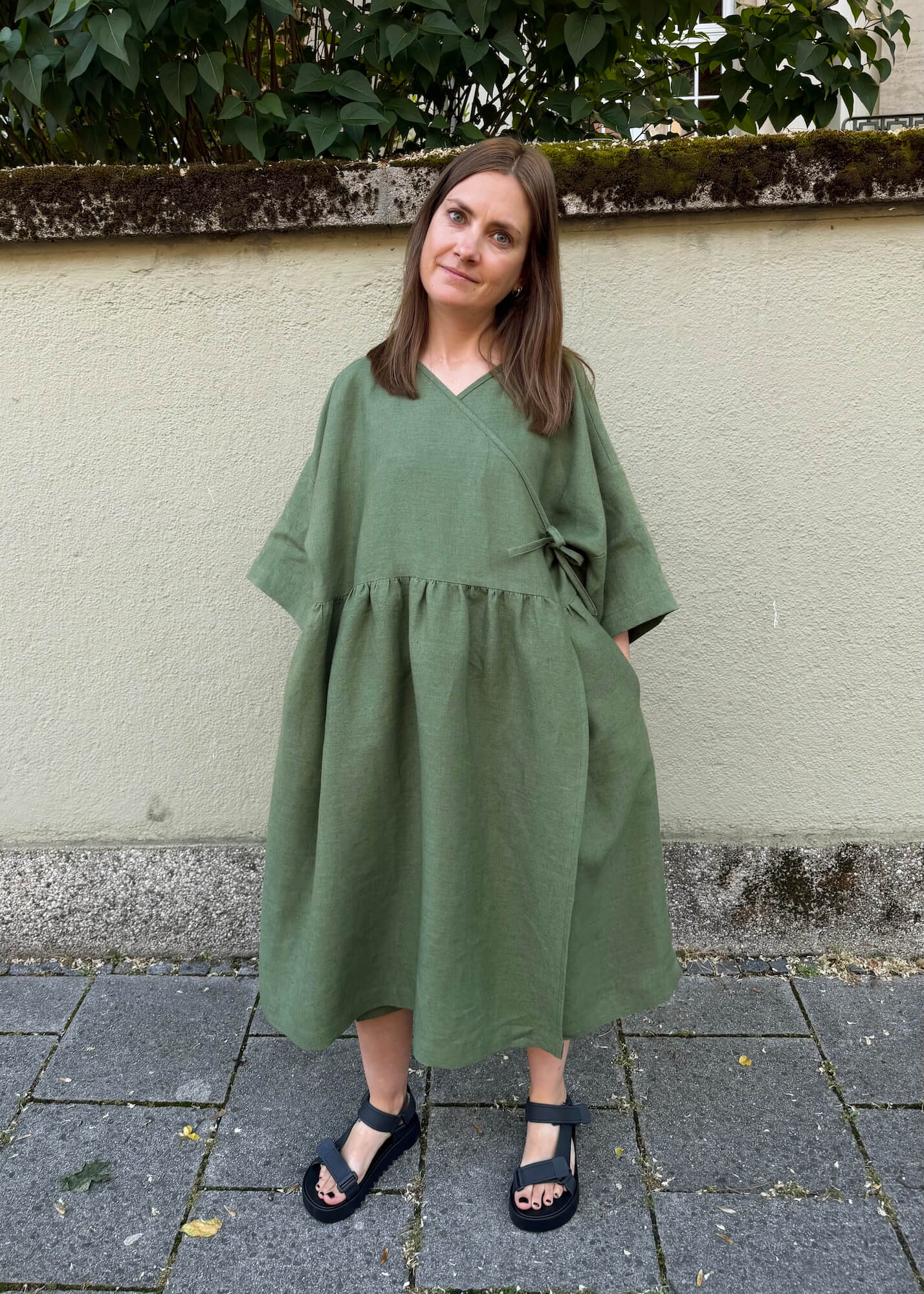
Indigo Indogo Helios Dress made with FS Dried Herb Midweight linen
Where is home and how does it affect your creative practice?
While Munich has captured a big part of my heart, Australia will always be home.
Both my life in Munich and Australia have shaped my creative practice in different ways.
Munich is beautiful, practical, and steeped in tradition. It’s quite conservative style-wise, and smart casual is very much the norm, nothing too loud or over the top. I’ve actually been stopped more than once on the street when wearing something a bit too bold and colourful by Munich standards.
Living in Munich has definitely made me more mindful of functionality in the way I dress and sew. Especially since I ride my bike everywhere here. Summers are shorter and the winters are long, so I’ve also become very good at layering my summer makes with thermals.
At the same time, I still draw a lot of influence from my Australian roots. Back home, fashion and lifestyle in general feel much more laid-back and easygoing. You can get away with bright colours, a relaxed and casual style, and even go barefoot most of the time.
I think Munich has taught me thoughtfulness and practicality, while Australia continues to inspire me to be playful, bold, and comfortable in the way I design and dress.
As a child, what was your first encounter and memory of beauty?
This is definitely not my first encounter with beauty, but when I read this question, what came to mind was realising how much beauty there is in originality. The idea that you don’t have to follow rules or trends when it comes to beauty and your style. It’s something personal.
I think I really started to understand this in my teens that beauty isn’t something you have to follow, but something you can create by being yourself. I’ve always been drawn to things that are a bit different or unexpected rather than following what everyone else is doing.
Has your sewing practice changed your relationship to your body image and self-acceptance?
I would say yeah, it has.
No one knows your body better than you do. As a sewist, you’re in the best position to understand what you want and need from your clothing. It makes sense that you naturally create pieces that you feel most confident in.
For me personally, I don’t like anything tight-fitting. I prefer looser, more relaxed silhouettes, and I love an elastic waistband. That’s what I feel most comfortable in, and it’s what helps me feel confident.
What are your seven favourite sewing patterns?
Can I just say pretty much anything from Matchy Matchy Sewing Club?! Honestly, I love their patterns and there aren’t many I haven’t made. I’m really into their whole design approach of simple, smart patterns that still give you a lot of room to add a bit of individuality. They are just relaxed, wearable pieces that fit how I like to sew and dress.
But if I had to narrow it down, some standout favourites that I wear on repeat include:
- Archer Work Pants from Matchy Matchy Sewing Club: I’ve made these so many times. I just love the barrel shape, elasticised waist, and all the pockets, panelling, and dart details.
- Pintuck Poet Blouse also from Matchy Matchy Sewing Club: This is such a lovely, feminine pattern with beautiful pintuck and bow details.
- Rue Quilt Coat from Spaghetti Western Sewing: I live in this jacket during the cooler months. It caught my eye straight away, and what really sealed it for me was the interior strap that lets you carry it like a bag when you’re not wearing it. So cool!
- Petal Dress from Soft Bodies: A more recent make, but I absolutely love it, especially the dramatic curved bodice. Plus, their pattern instructions are some of the best I’ve come across.
- Ruffle Jacket from Ford and Guy: This is such a unique pattern. I haven’t come across anything quite like it to be honest. With its relaxed fit, dropped shoulders, and lots of gathering, it’s still one of my all-time favourites.
- ZW Workwear Jacket from Brigitta Helmersson: I love the concept of zero waste sewing patterns. They feel just like a puzzle and really slow you down. I really like the dropped shoulder and dart detailing on this one.
- The Florence from Merchant & Mills: I’ve made both the top and dress versions of this pattern multiple times, including a lilac linen one that I wore to my sister’s wedding back home in Australia, so it holds a special place for me.
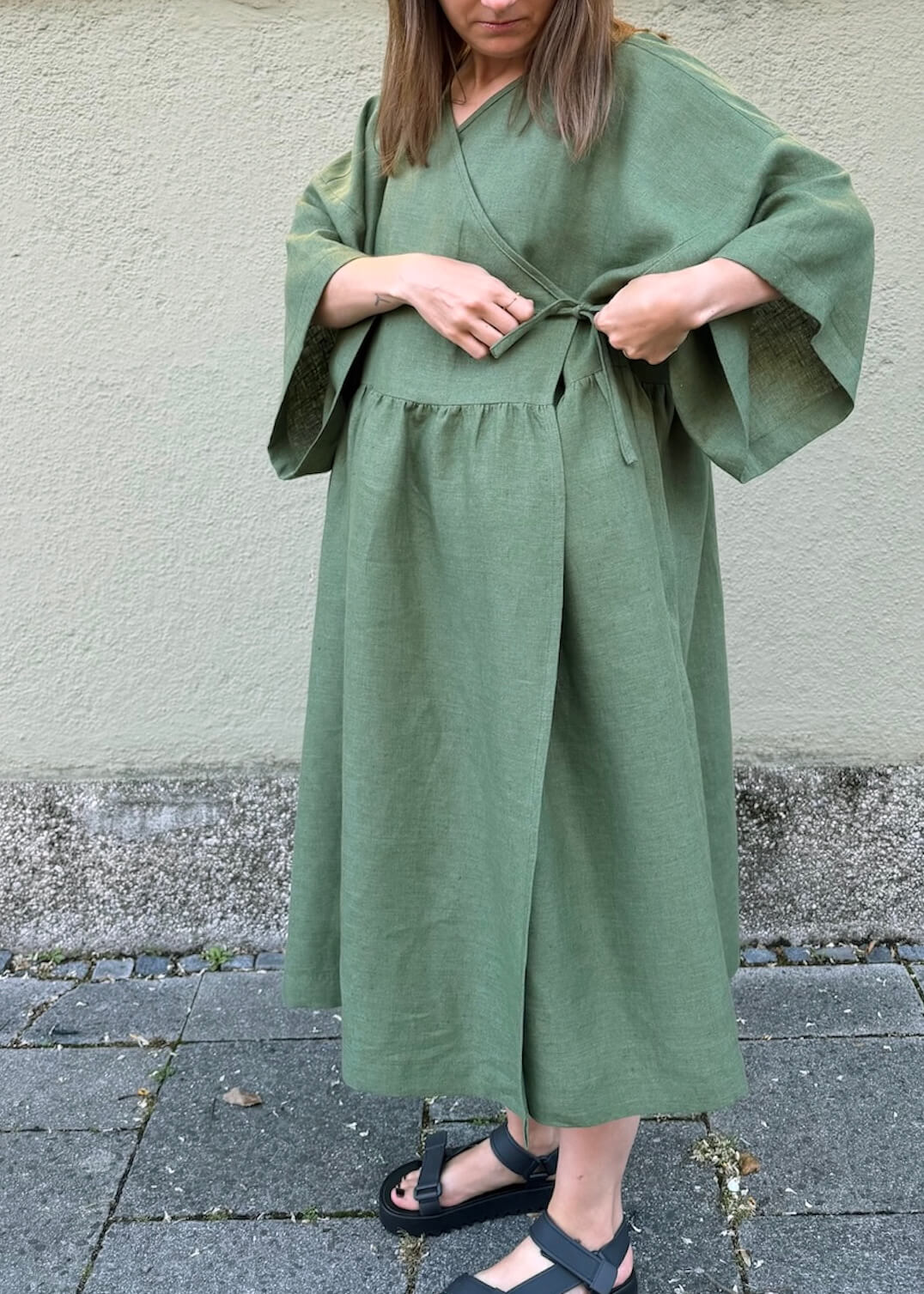
Indigo Indogo Helios Dress made with FS Dried Herb Midweight linen
Do you have a community of makers around you or do you find you are on your own?
Not really, no, and I actually don’t mind being on my own in that way. I’m quite introverted, so large or in-person meet-ups aren’t really my thing. Sewing has always been a more personal, quiet activity for me.
That said, I do turn to the broader sewing community on Instagram for a sense of support and inspiration when I need it. I have also found interacting with the community around The Thread through my articles really rewarding.
And I’m never completely alone. I always have my mum to turn to for advice or to bounce ideas off.
How important is it to make something with your hands?
This is probably one of the most important things to me. I’ve always been a person who needs to be working on at least one project (often multiple) at all times. I find it hard to just sit still. I’m always making something in some capacity. Recently, I even took up knitting as another way to channel that need to make, and it’s been perfect for the long, cold winters here in Munich.
What has been the most rewarding sewing project you’ve completed so far and why?
I have two.
The first would be my Year 12 textiles major project. It was a version of the ivory Chanel camellia dress (I believe from 2006) that Gemma Ward wore, featuring 3D camellias at the hem. It was selected as one of the top projects in the state and toured around Australia, which was a pretty cool experience as an 18-year-old.
The second would be a particular dress from my seven body graduate collection at university. It’s a sleeveless, floor-length black dress with layers upon layers of gathered frills in some of the most beautiful netted tulle, beaded, and sequinned fabrics. I still have the offcuts safely tucked away as they were just too beautiful to get rid of. Honestly, I don’t think I’ve ever gathered so much fabric in my life.
Both pieces are now very well looked after by my mum back home in Australia. I just wish I had more photos of them from the time.
What is more important to you – the process or the final product (ie your garment)?
Can I say both equally?
I’m happiest and most comfortable when I’m behind my Bernina sewing machine. I mean it when I say sewing is like therapy for me. The process is what allows me to slow down, get in the zone, challenge myself, learn new skills, and slowly watch an idea come to life.
But I also find the final product just as rewarding. There’s something pretty special about wearing a garment you’ve made yourself, and I feel a real sense of pride in being able to say, “I made this.” I love that it reflects my personal style exactly, and it’s cool knowing that no one else will have the same piece.
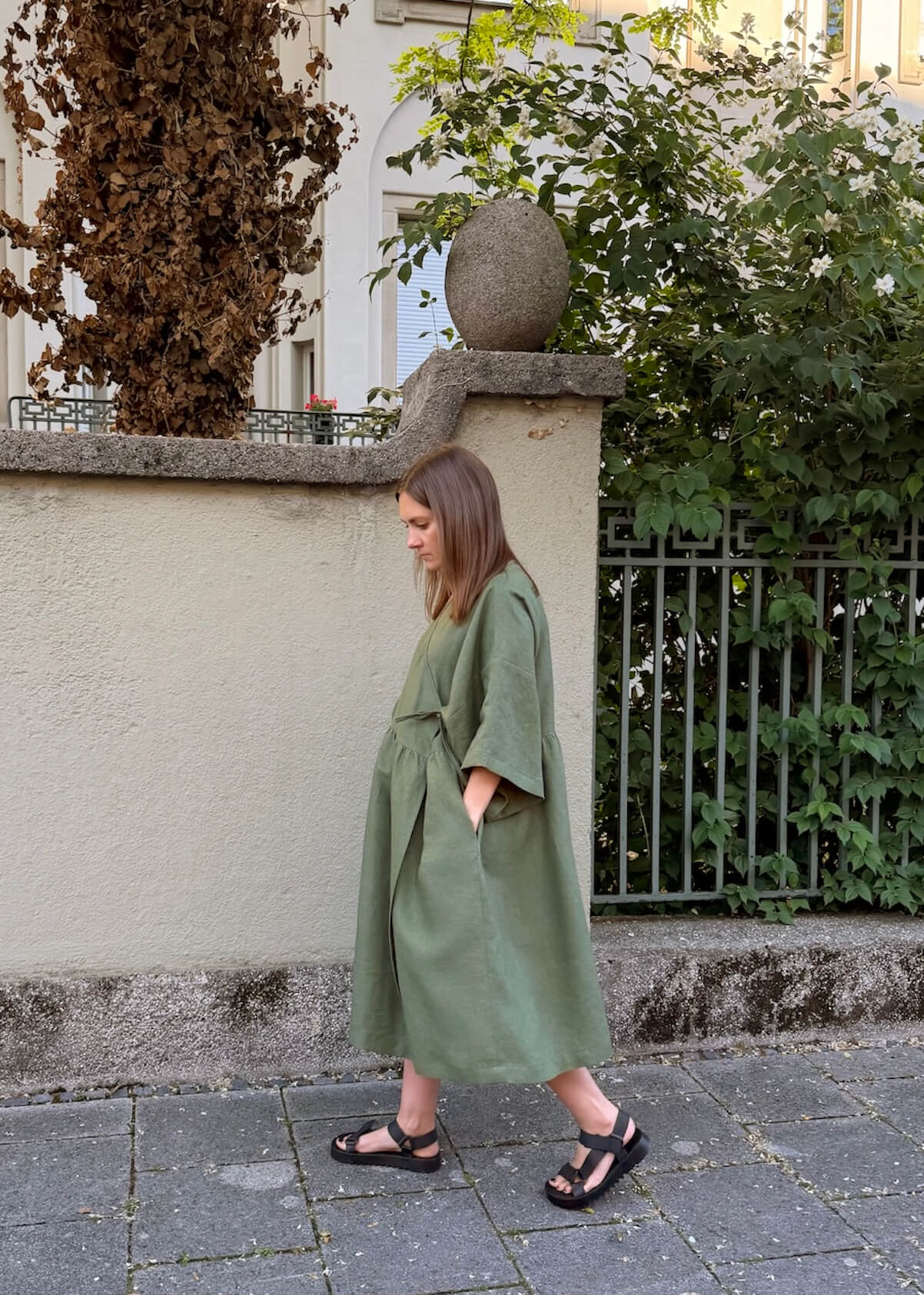
Indigo Indogo Helios Dress made with FS Dried Herb Midweight linen
What does success mean to you?
This is kind of a tough one to answer for me. I’m a perfectionist and tend to set very high standards for myself. I can be quite hard on myself, so the idea of success, and accepting what I’ve achieved, are things I’m constantly having to work on.
For me, especially with sewing, success means creating something that feels aligned with who I am, reflecting my style and values, and something I genuinely want to wear and share.
If I can step back from a finished piece and feel proud of both the process and the outcome, even with its imperfections, then I see that as success.
What have you chosen to make out of FS linen and why?
I chose to make the Helios Dress from Indigo Indigo in FS linen, specifically the IL019 Dried Herb FS Signature Finish.
While studying pattern making at university, I always loved the almost jigsaw, puzzle-like challenge that pattern making and cutting brought with it. Zero waste patterns just take that idea to a whole other level. It’s essentially about laying out pattern pieces in a way that ensures no fabric goes to waste. It’s a bit like a game of Tetris. You can even draw your pieces directly onto the fabric using a cutting plan and template, which also eliminates paper waste along the way. Win-win!
I really love how simple shapes can come together to create something 3D. The whole process of mapping, laying out, and cutting pieces is one of my favourite parts.
The Helios Dress had been on my radar for a while. I am drawn to oversized, loose-fitting garments, gathering details, and easy summer pieces in general. And linen just felt like the perfect fabric for this dress. I’m also a sucker for green, so the Dried Herb colour was a no-brainer for me.
What is it like working with fabrics-store linen?
Linen is honestly my absolute favourite fabric to work with. At this point, I’d say about half my wardrobe is linen, and I wear it all year round, even here in Munich. So it’s safe to say I’ve worked with a lot of linen and from all over the world over the years. However, the FS linen really stands out.
It was an absolute dream to work with from start to finish. It behaves beautifully when cutting and stitching, and has that relaxed aesthetic you expect from linen, along with all its natural charm of visible slubs, creases, and texture that just add to its appeal. It also washes beautifully and I am sure it will just get better with wear over time.