
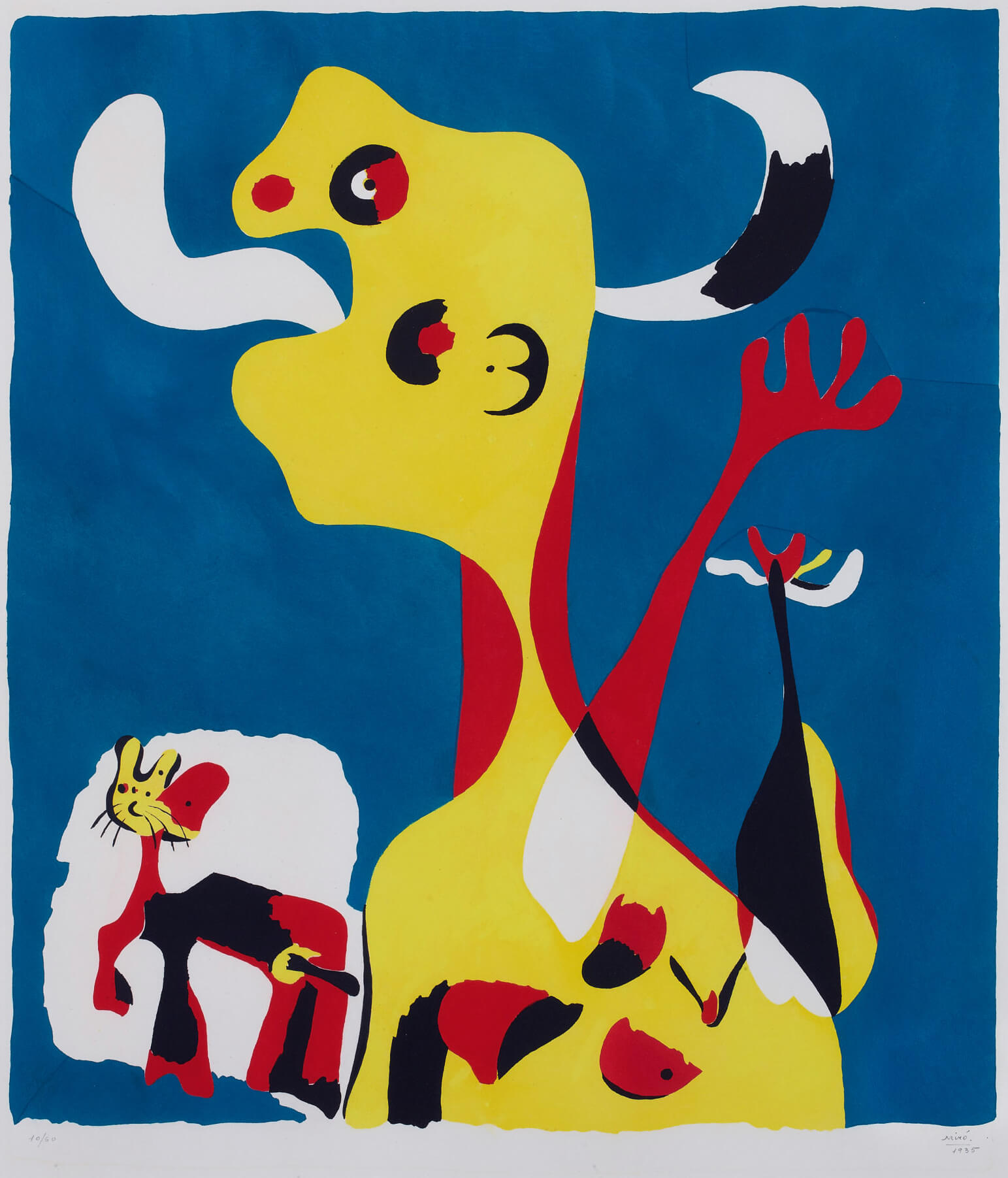
Woman and Dog Before the Moon, 1936
Spanish early 20th century painter Joan Miro had an enduring obsession with daring, hot shades of red like Pure Red Linen, scattering them like jewels throughout his art or streaking them across muted backdrops to add theatrical, passionate drama. His experimental art spoke of a life lived on the edge; through war, hardship and itinerant travel, he clung to his artistic vision as a means of self-expression that could anchor him in the moment, finding in it a solace and security when it seemed like all else might be lost in an instant. He wrote in his diary, “Painting must be fertile. It must give birth to a world… it must fertilise the imagination.”
Miro was born in Barcelona in 1893. His father tried to push Miro into a career in business, but following a spell of mental illness Miro came to realise art was what he needed to be happy. He moved to Paris in 1920, where he mingled with the Surrealist artists including Andre Breton, and thereafter his art became shaped by the realms of dreams, the unconscious mind, and automatism. He wrote, “Every idea has to develop in my unconscious, and sometimes it takes years… The starting point is absolutely irrational, sudden and unconscious: I start off blindly.”

FS All-purpose Pure Red FS Signature Finish
By the 1930s Miro had already moved back and forth between Spain and France. As civil war broke out in Spain and Fascism was rising across Europe, his art reflected the troubled, tumultuous times he was living through, and the patriotism he felt for his homeland. Curious, distorted bodies and animals began to populate his art, as he tried to make sense of his inner emotions. He wrote, “I work in a state of passion, transported. When I begin a canvas, I’m obeying a physical impulse, the need to throw myself; it’s like a physical outlet.”

In Woman and Dog Before the Moon, 1936, a strange story unfolds, with the woman and dog rendered in golden yellow, and spliced into with searing passages of hot, fiery crimson. “I paint in a frenzy, with real violence so that people will know that I am alive, that I’m breathing, that I still have a few more places to go. I’m heading in new directions,” he wrote in his notebook.
Painting (Woman with Moon and Stars), 1949, made more than a decade later, is one of many paintings Miro made featuring constellation patterns. Having already lived through the war by now and periods of exile, he saw his star paintings as a means of escape from the struggles of daily life. Painted in what would become his trademark playful, eccentric style, with loose, biomorphic lines and scattered patches of vivid colour, the work reflects his lean towards a playful, child-like language of expression. Searing hot panels of vivid red seem to bring burning life into the scene, layered like calligraphic writing across a scumbled, loosely painted beige backdrop. “The work must be conceived with fire in the soul,” he wrote, “but executed with clinical coolness.”
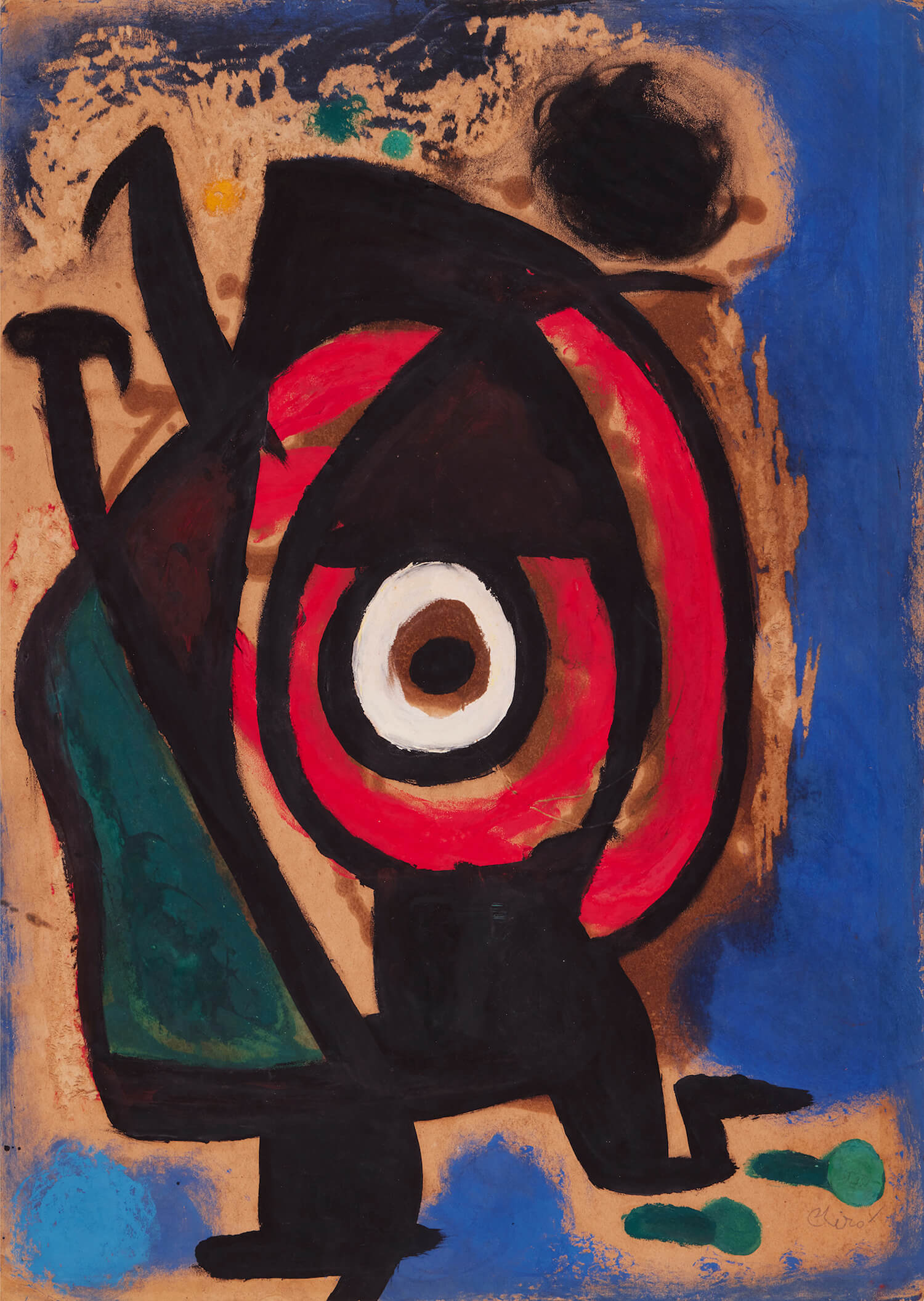
Personnage, 1976
By the time Miro made Personnage, 1976, he had reached a much more settled phase in life; having found success in art, and established a home in Mallorca, he felt free to explore art with reckless abandon, continuing to make art long into his 80s. In this expressive panel we see daring streaks of blue black, and blazing red applied with his fingertips, forming shapes suggesting an animalistic form emerging from the shadows. “The older I get and the more I master the medium,” said Miro in his later years, “the more I return to my earliest experiences. I think that at the end of my life I will recover all the force of my childhood.”