
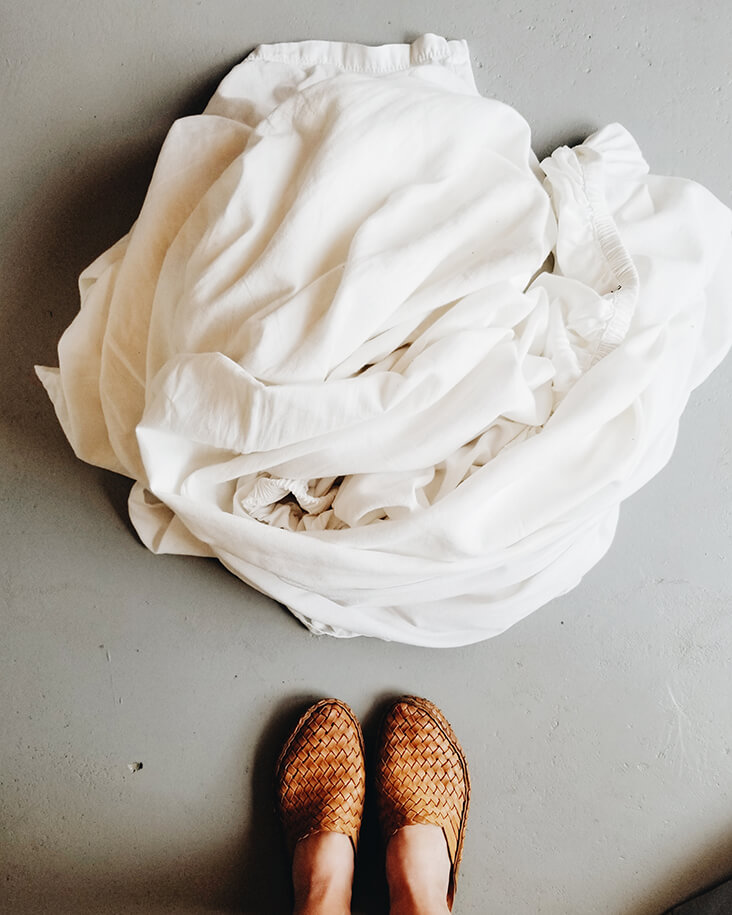
Knowing how to care for your clothing is a big component of creating a well-loved wardrobe that will last. The same is true for textiles in your home.
Linen is an incredible fabric for many reasons. It is natural, strong, and high quality. Its durability, breathability, and resistance to bacteria sets linen apart from other natural fibers. When cared for properly, it gets softer and more beautiful with age while maintaining its shape, making it a good choice for clothing, towels, sheets, and more.
Overall, I have found linen to be a low-maintenance textile that is easy to sew, wear, and wash. This is coming from someone who owns white linen sheets and likes to sip coffee in bed, so plenty of washing experience over the years.
In general, I always recommend looking at the fabric content and washing instruction tags on your specific item first. Something that feels like linen might actually be a blend with another fiber, so it’s always best to double check the tags.
Here is a quick rundown of how to care for your linen items:
To Wash
Use the gentle cycle on your washing machine and wash with similar lightweight fabrics. Of course, washing by hand in a large sink or bathtub is an option as well.
Wash in lukewarm or cold water with mild detergent. Hot water can cause linen to shrink.
I separate light colors from dark colors to keep them looking sharp.
Avoid fabric softener. Linen will soften on its own over time.
Do not use bleach or detergent with a whitening agent. Even on white linen, the bleach will blotch the fabric and damage the fibers.
To Dry
Tumble dry on low. High heat will cause the fibers to break down faster and possibly shrink.
If the care instructions require air drying, lay flat over a drying rack. Avoid using clothespins, as they can cause stretch marks and deform the garment.
To Iron
Press on medium heat, preferably when the fabric is still a little damp out of the dryer.
Although I do not mind a little wrinkle in my clothing, I always press the pockets of linen pants and dresses to prevent any bulk around my hips.
For dark colors, press on the wrong side of the fabric.
Use the steam setting on your iron, especially if the material is dry.
Steamers work well for garments that are hard to iron.
To Remove Stains
Spot clean whenever possible. Get more life out of your textiles by not overwashing.
I simply use a dab of Dawn dish soap and cool water to wash out stains.
Baking soda and a few drops of vinegar are a good combination for stubborn stains.
Again, no bleach. Some people recommend an oxygenated bleach like OxiClean. However, I continue to have good luck with the dish soap technique and recommend starting there.
A lot of stains like blood, jam, pasta sauce, etc will usually wash out on a very cold wash setting.
Any questions? Do you have tips and tricks to add? I would love to hear them. Leave your thoughts in the comment section.
Happy sewing (and washing),
Morgann


20 Comments
[…] comfortable. As the fabric is lightweight yet durable, ?washing in cold water and opting for a gentle cycle ?helps ?maintain its color? and shape. We? avoid bleach or? harsh ?detergents to ?preserve ?the ?rust […]
[…] Pros include its lightweight and loose fit, which allows for comfortable layering, and ?its low-maintenance care instructions—simply hand wash or dry clean. Additionally, it features practical pockets for convenience. However, cons to […]
[…] Iron linen on medium heat while the fabric is slightly damp. For dark colors, press on the wrong side to avoid shine. This technique gives your curtains and upholstery a crisp, polished look. […]
[…] downside of linen includes wrinkling1, fraying, cost, care complexity2, limited elasticity, and shrinkage. It requires more delicate handling during production and wear […]
[…] Caring for Linen: How to Wash, Dry, Iron and Remove Stains […]
[…] while staying stylish. The 2024 trend focuses on tailored cuts and soft, neutral tones. Consult our linen shorts care guide3 to keep them wrinkle-free and […]
[…] Durability: High-quality natural fibers tend to last longer than synthetic options, ensuring your investment pays off over time. […]
[…] The dry cleaning process at home offers a straightforward and user-friendly approach to refreshing garments. At-home kits like Dryel have simplified this method, allowing you to efficiently manage your garment care. […]
Great tips on linen care! I love how simple yet effective these methods are, especially avoiding bleach and fabric softeners to keep linen looking its best. The reminder to use cool water and mild detergents is so important, and I appreciate the advice on drying to prevent shrinkage. Linen is such a beautiful fabric, and with the right care, it truly gets better with age. Thanks for sharing this helpful guide!
[…] characters, making proper care essential to maintain their allure. Here are some wash care and maintenance tips to ensure your tees stay in top […]
[…] your water-efficient washbasin is equally important. Routine cleaning and gentle care can extend the life of your fixture and keep it looking its best. Avoid harsh chemicals or abrasive […]
[…] Separate Colors: To prevent color bleeding and fading, separate your clothes into light and dark colors before washing them. This will help maintain the vibrancy of your favorite femboy outfits. […]
[…] https://blog.staging.fabrics-store.com/2020/09/10/caring-for-linen/ […]
When I stained my newly created boxy linen shirt., I tried a few of these tricks, nothing worked. Dyed the shirt a dark pink. Problem solved.
The very best way to dry any linen, whether towels, sheets or clothing, is to line dry. After we switched to linen sheets and towels, I had my husband make me a clothesline in our back yard. After washing my items I take them outside to dry in the breeze. Since we live in the southwest, and our winters are usually rather mild, I hang dry all year long. I do not like to put any linen in the dryer. When I first get my linen fabric, I do prep it by washing in hot water twice and drying in the dryer, but after I have made my sheets or whatever, no more dryer. I don’t want to prematurely wear my linen out before it’s time! We really love all our linen and I am so happy to finally be rid of the nasty terry cloth towels. We will never go back!!
I made the linen tank from this site for my granddaughter this summer. While I was in the process of working with the linen I read somewhere (I can’t remember where!) that you can spray your linen so it’s damp, and smooth it out with your hand. I tried it, and it does work! Linen always looks kinda wrinkled, anyway!
This is what my husband and I call the “poor man’s iron” or you could also call it the “lazy man’s iron” ;). It works with quite a few types of fabrics and I rarely bring out my iron anymore. Just be sure not to get it too wet, a light mist is usually okay (at least for other fabrics- I’m new to linen, except the washcloths that I knit with linen yarn).
For cleaning stubborn stains (think tea that has already a ady set in or been washed and dried), use the Dawn dish soap, but make sure to really work the soap INTO the fibers. Stains are most easily released when the fibers are really massaged. Remember not to scrub or stretch unnecessarily, but rather ‘massage’ the fibers.
Linen is my favourite fabric for clothing. I don’t treat it any different, and it never ceases to please me. To be honest if you want something to last forever you can definitely treat it special. But in this day and age, we all have our favourites but want something new on a regular basis. I try to make clothes that are styled to last through the ages, but even I like to change my clothes up once in a while. And Fabric-store.com has the best!
Which of your linens is the least wrinkly when washed and dried in a washer and dryer? I want to sew a linen jumpsuit for my daughter (she asked for it), but she’s a busy woman who seems to be allergic to her iron and ironing board. Thanks for any advice – Bonnie