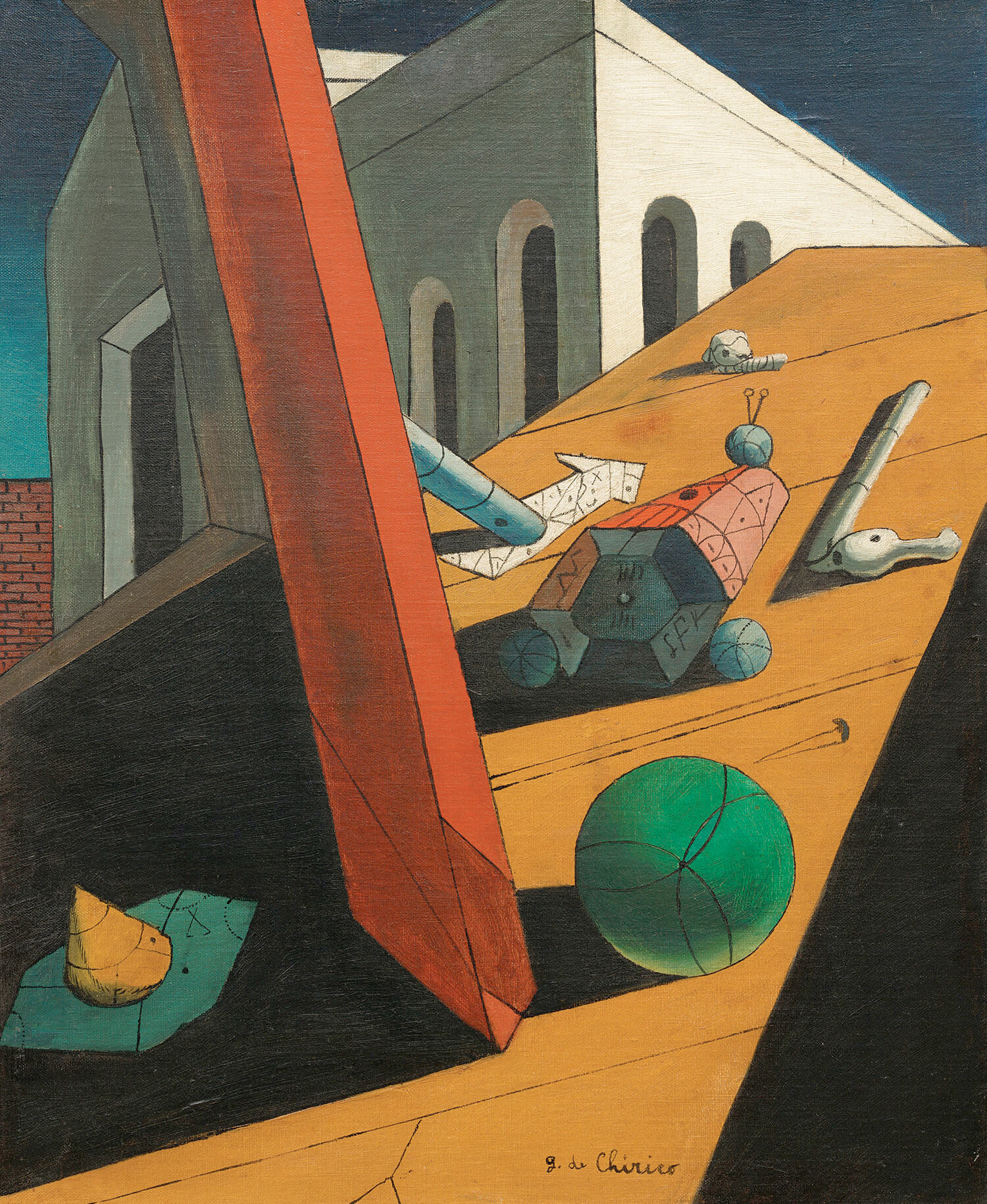
The Evil Genius of a King, 1914–15
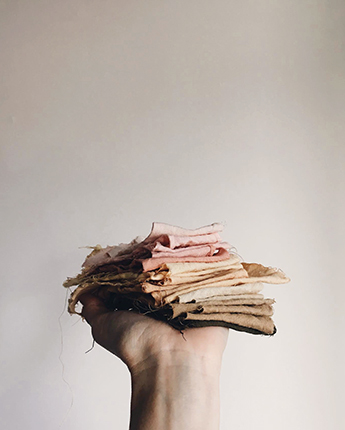
The soft, sandy orange of Chamois Linen often featured in many of Italian artist and writer Giorgio de Chirico’s best-known paintings, conveying the scorched, sunlit earth of Italian piazzas surrounded by crisp, razor-sharp shadows. Through the use of such stark lighting and the curious staging of uncanny objects in barren, desolate places he imbued his paintings with a disquieting sense of mystery and intrigue. He wrote, “What is especially needed is great sensitivity: to look upon everything in the world as enigma…”
Born to Italian parents in Greece in 1888, De Chirico trained as a painter in Athens, Florence, and Munich. In Munich he was influenced by the Symbolist German artist Max Klinger, and the Swiss painter Arnold Bocklin, imbibing the same eerie, usual lighting effects into his own art. Following graduation, he moved to Milan, before settling in Florence. While in Italy he immersed himself in the work of the German philosophers Friedrich Nietzsche and Arthur Schopenhauer, seeking to invest their notions of transcending daily life into his art.

FS Chamois Signature Finish Midweight linen
Between 1910 and 1917, De Chirico developed the ‘metaphysical’ style that would occupy him for the rest of his artistic career, creating strange, dreamlike plateaus in abandoned city squares, or crowded interiors. Along with the artists Filippo De Pisis and his brother, Alberto Savinio, they developed the short-lived art movement Scuola Metafisica. He observed, “to be really immortal, a work of art must go beyond the limits of the human: good sense and logic will be missing from it. In this way it will come close to the dream state, and also the mentality of children.”

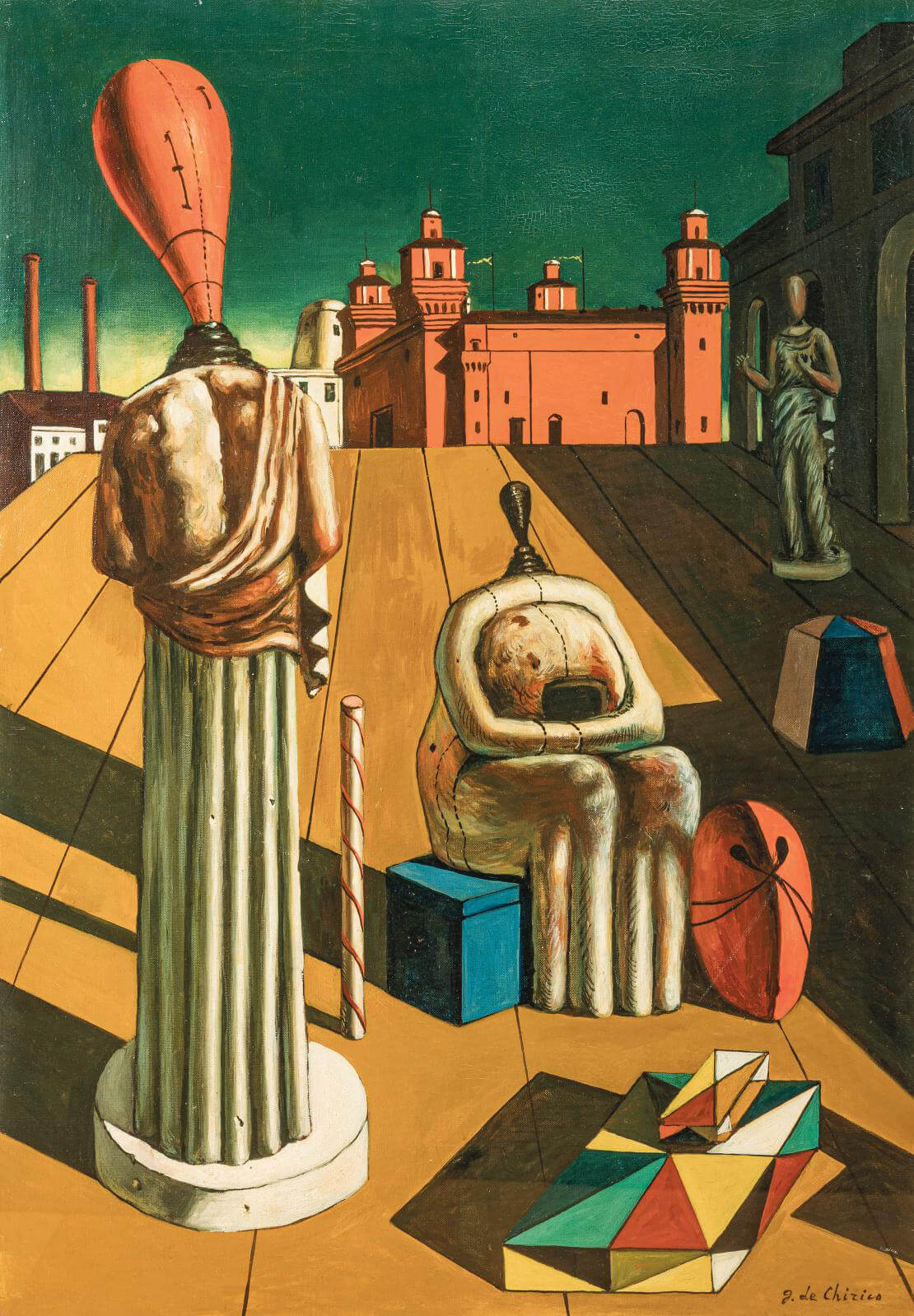
The Disquieting Muses, 1916-18
In The Evil Genius of a King, 1914–15, De Chirico paints a curious, almost indecipherable collection of objects that defy the conventional logic of space, tilted at strange angles, yet seemingly caught suspended mid-motion. A crisp passage of sandy, wooden orange leans across much of the strange scene, carrying with it the invocation of the Italian sunshine, made believable through the stark black shadows than span across its surface. This vivid shade of orange contrasts sharply with a white, arched building and deep blue sky in the distance, a colour combination that seems to invoke the heady heat of the Mediterranean.
The now iconic painting, The Disquieting Muses, 1916-18, depicts a series of eerie statue-like forms, or ‘Muses’, wearing draped, classical clothing, arranged into an informal grouping, set within a desolate, abandoned street scene. De Chirico made this work while living in the Italian city of Ferrara, and he includes the deep red Castello Estense in the distance. The red mask and staff are a nod towards Melopene and Thalia, the Greek Muses of tragedy and comedy shown in the foreground, while the distant statue is Apollo, the leader of the Muses. A warm, golden shade of orange expands across much of the image, featuring drawn lines to resemble wooden panels, made brighter with the inclusion of crisp, dark shadows that reach out across its surface, rendered with mathematical precision.
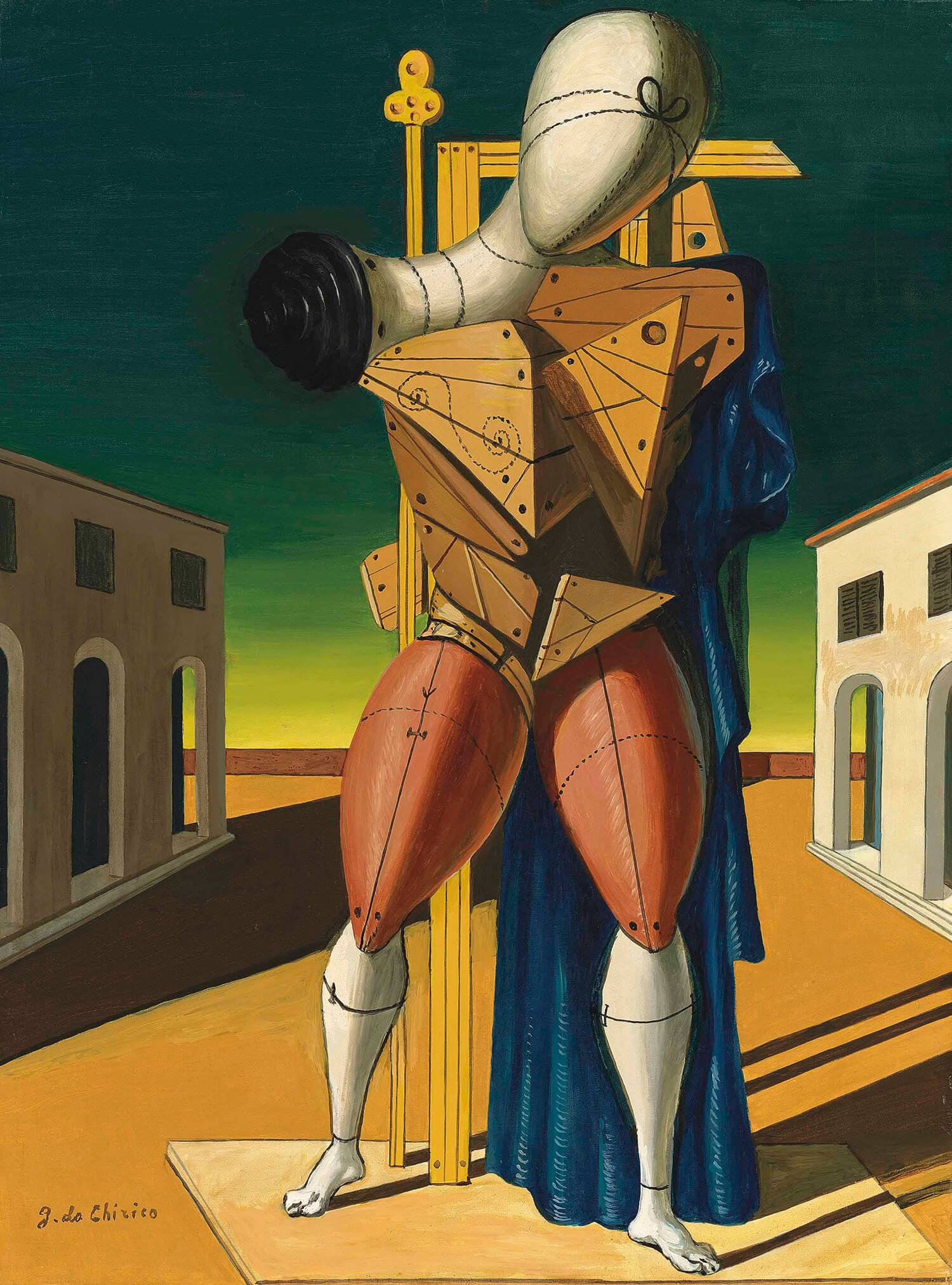
Il Trovatore, 1917
Another of De Chirico’s famed ‘Metaphysical’ paintings, Il Trovatore, 1917, conveys a surreal composite mannequin made from fragments of set squares, measuring instruments, and other geometric or stitched pieces, with head titled into a moment of quiet reflection. Around this uncanny, disquieting figure, a scene resembling a classical piazza opens out, with dusty, sandy ground rendered in soft, mellow orange, made vivid by the angular, streaked shadows, while in the far distance the sun sets, casting an unsettling green, ambient glow across the sky.