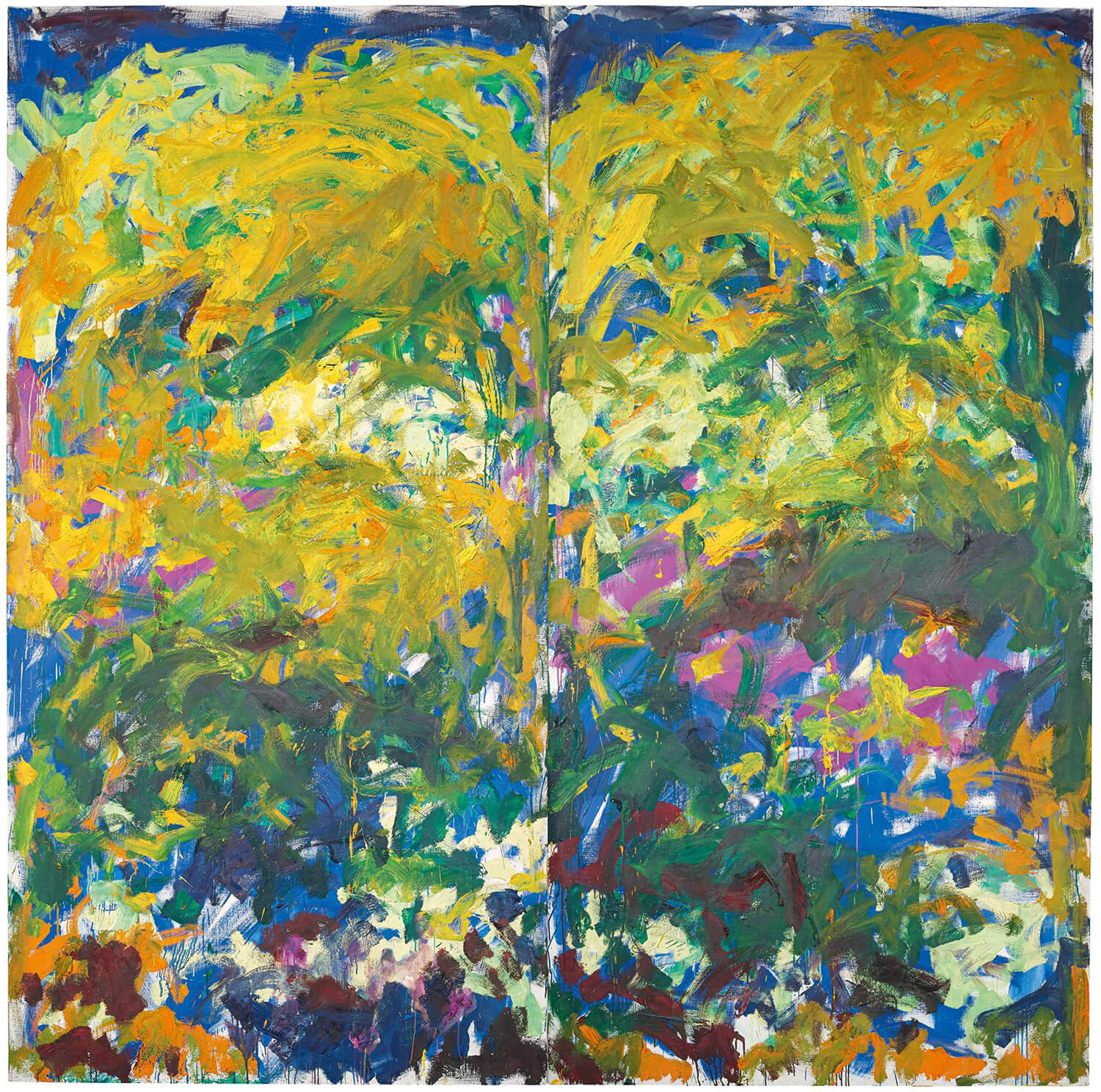
Joan Mitchell, La Grande Vallée IX, 1983
American Abstract Expressionist painter Joan Mitchell built her career on the exploration of colour, gesture, and self-expression, making frenzied paintings from interlocking ribbons, bands, and streaks of paint. In her art vivid shades of indigo and purple like Amethyst Orchid often appeared as vibrant accents amidst other cooler, or warmer shades, conjuring up gardens in full bloom, or the flickering passages of light and shadow across moving water. The natural world was a constant source of inspiration, particularly following her relocation from New York to France, where she soaked up the influence of the French Impressionists and Post-Impressionists.

FS Amethyst Orchid Signature Finish Midweight Fabric
Mitchell was born in 1925, and her art career began when she trained as a painter at the School of the Art Institute of Chicago. She moved to New York in 1949, and became one of only a handful of successful and influential female Abstract Expressionist artists including Lee Krasner and Helen Frankenthaler, who rubbed shoulders with the macho New York School painters Jackson Pollock and Willem de Kooning. In the 1950s, Mitchell moved to France, moving around before settling in Paris in 1959. After this time her art fused New York School abstraction with European influences including Claude Monet, Paul Cezanne, and Vincent van Gogh.
Her admiration of Monet was reflected in the Mitchell’s choice to move into a home in Vetheuil, near Monet’s former home. However, she later stated in an interview that her art moved beyond his imitation of nature, noting, “I would rather leave nature to itself. It is quite beautiful enough as it is. I certainly never mirror it. I would like more to paint what it leaves me with.” However, the scale and wonder of her paintings, particularly those made in Vetheuil, can be compared with Monet’s late career studies of his garden in Giverny, matching the same free, expressive brush marks, pastel colours, and panoramic or monumental scales.

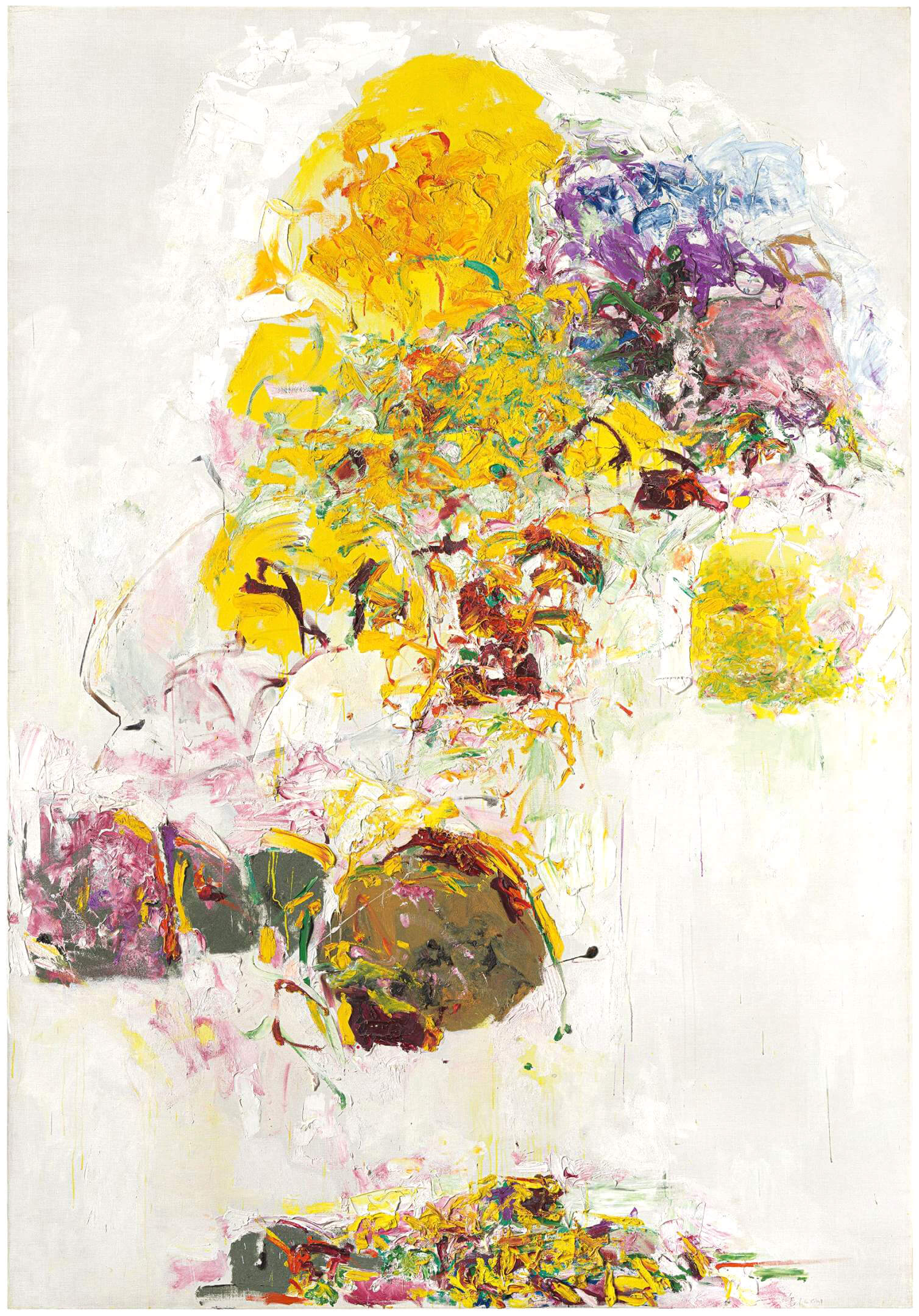
Joan Mitchell, Sunflower, 1969
In the four-part series of canvases title La Vie en Rose, 1979, named affectionately after the famous French Edith Piaf song from the 1940s, we see Mitchell experimenting with a pared back, limited palette of purple, lilac, black, and blue. Free, energised marks are arranged into syncopated, rhythmic patterns that rise on the left and right panels, and gently dip in the centre, as if we are looking through undergrowth into a deep valley or pool of water. In the distance, hazy lilacs form atmospheric, cloud-like blooms across the background, invoking the fresh vitality of a summer’s day, while scattered shades of darker purple intermingle with other deeper shades on its surface, suggesting fertile plants or flowers in the foreground.
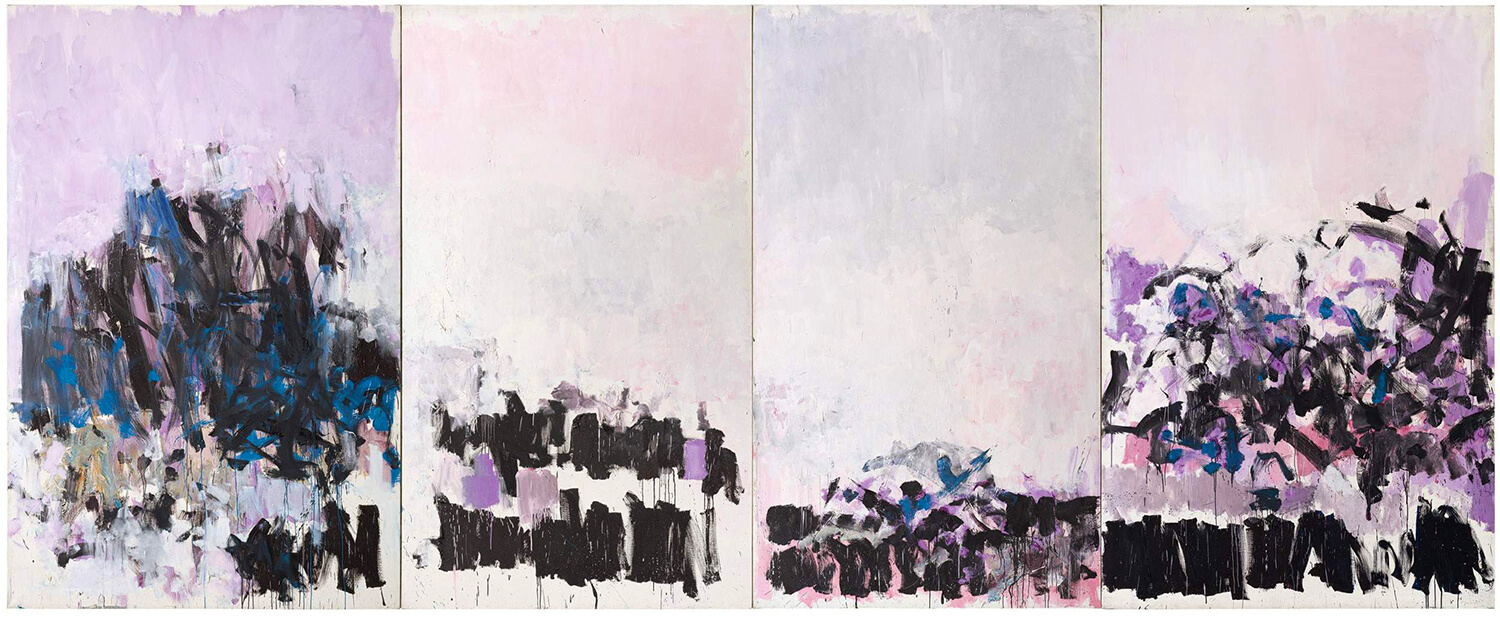
Joan Mitchell, La Vie en Rose, 1979
Made in the same year, Mitchell’s two-part painting Untitled, 1979, plays with the contrasting, complimentary hues of purple and yellow, intermingled together to form an appealingly dense patchwork of textural brush marks laid over one another in furious stripes, bands, streaks and jig-zags. This flurried pattern of angry, energised marks suggests bristling movement through tangled patterns of fervent undergrowth, or the shimmering breeze shifting through tree leaves, invoking the artist’s desire to convey the abstract and ephemeral experiences felt within nature.
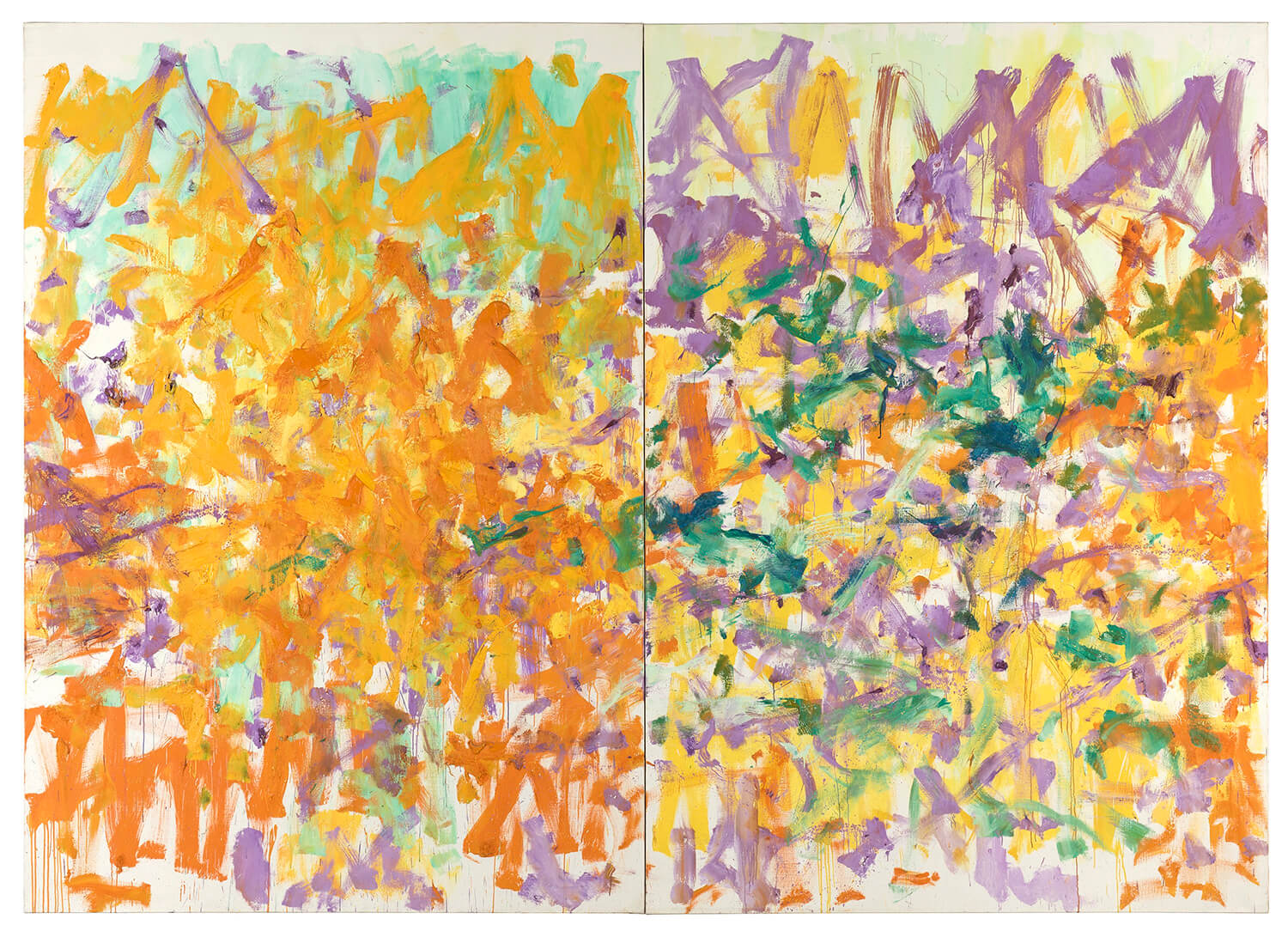
Joan Mitchell, Untitled, 1979
In Mitchell’s later painting titled Sunflowers, 1990-91, she paints a series of circular shapes resembling flowers or plant forms, which seem to float on a white, abstract ground. Despite the painting’s title, her allusion to sunflowers is more obscure, with thick tangles of paint applied in an array of vibrant, colourful hues that conjure up the abundant sensations of energy, growth, movement and life. Scattered passages of purple ripple throughout the canvas, carrying with them an energised, electrifying brightness, particularly in amongst a sea of darker, moodier, and more muted naturalistic tones.