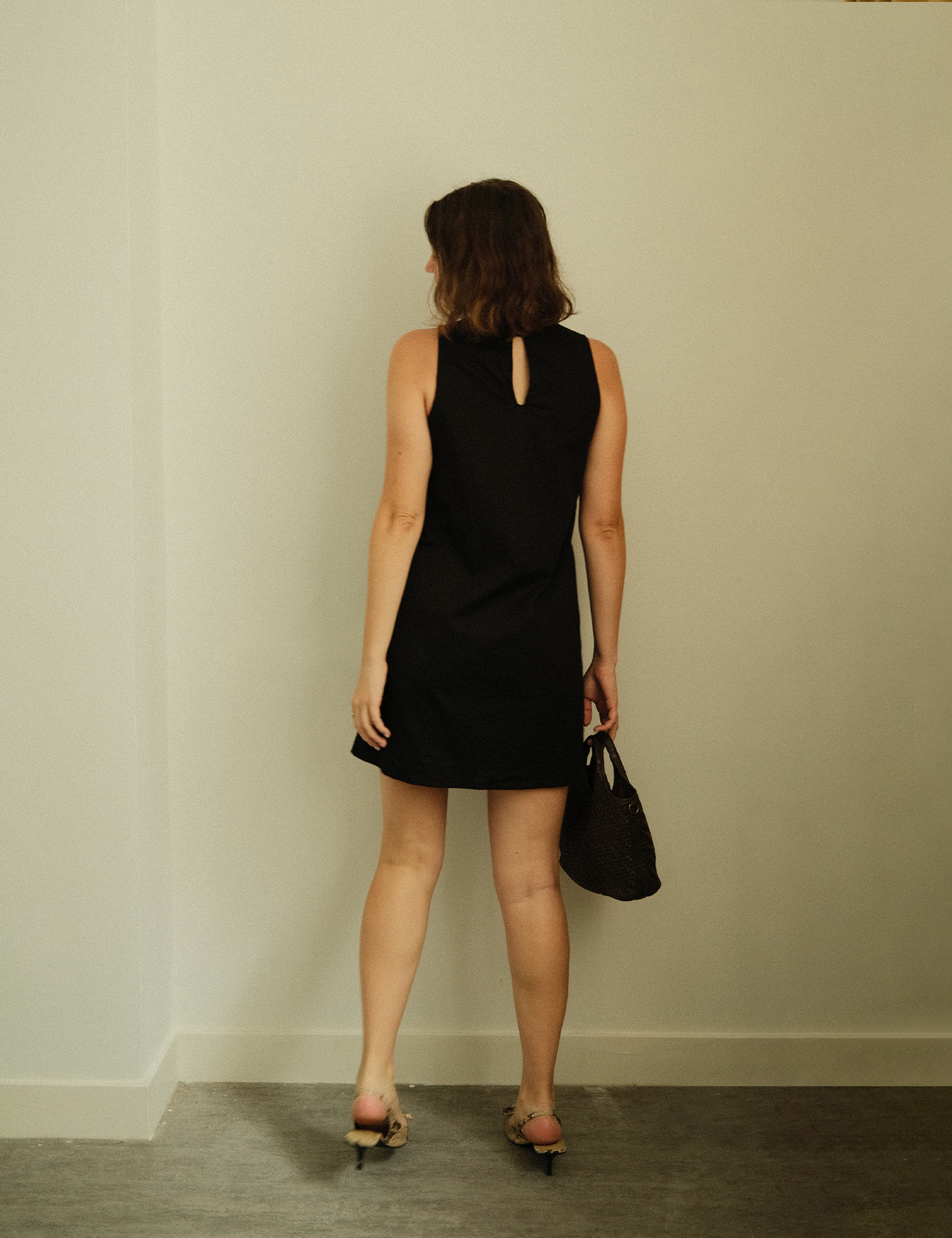
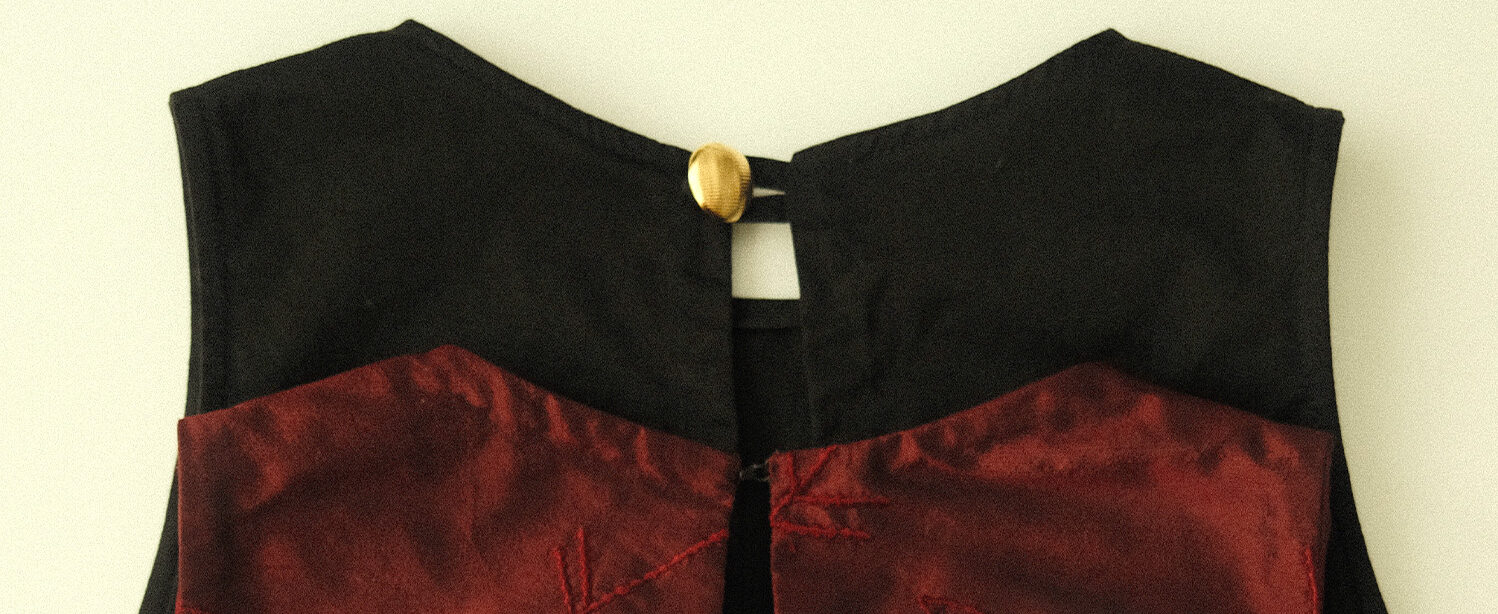
Back view of the Mona Dress
During my latest seasonal closet rotation, a few gaps emerged that I targeted to approach early in this year’s summer sewing. The first thing that came to my attention was that somehow, I didn’t have one of the most basic pieces one could have in their closet, a black shift dress. Next, I noticed there wasn’t a lot of texture. Cotton jerseys, poplins, and twills sit comfortably alongside plain weave linen and silk as the primary materials in my closet, and it showed. Finally, while I love my collection of me-made button-ups, I could really use a fun going-out top.
Always eager to tackle a task head on and efficiently, I saw the Fabrics Store’s Mona Dress as a way to achieve all three. Through the dress’ timeless A-Line silhouette and minimal keyhole back closure, the design provides a solid foundation for a variety of fabrics to lead the way and really define the overall tone of the style.
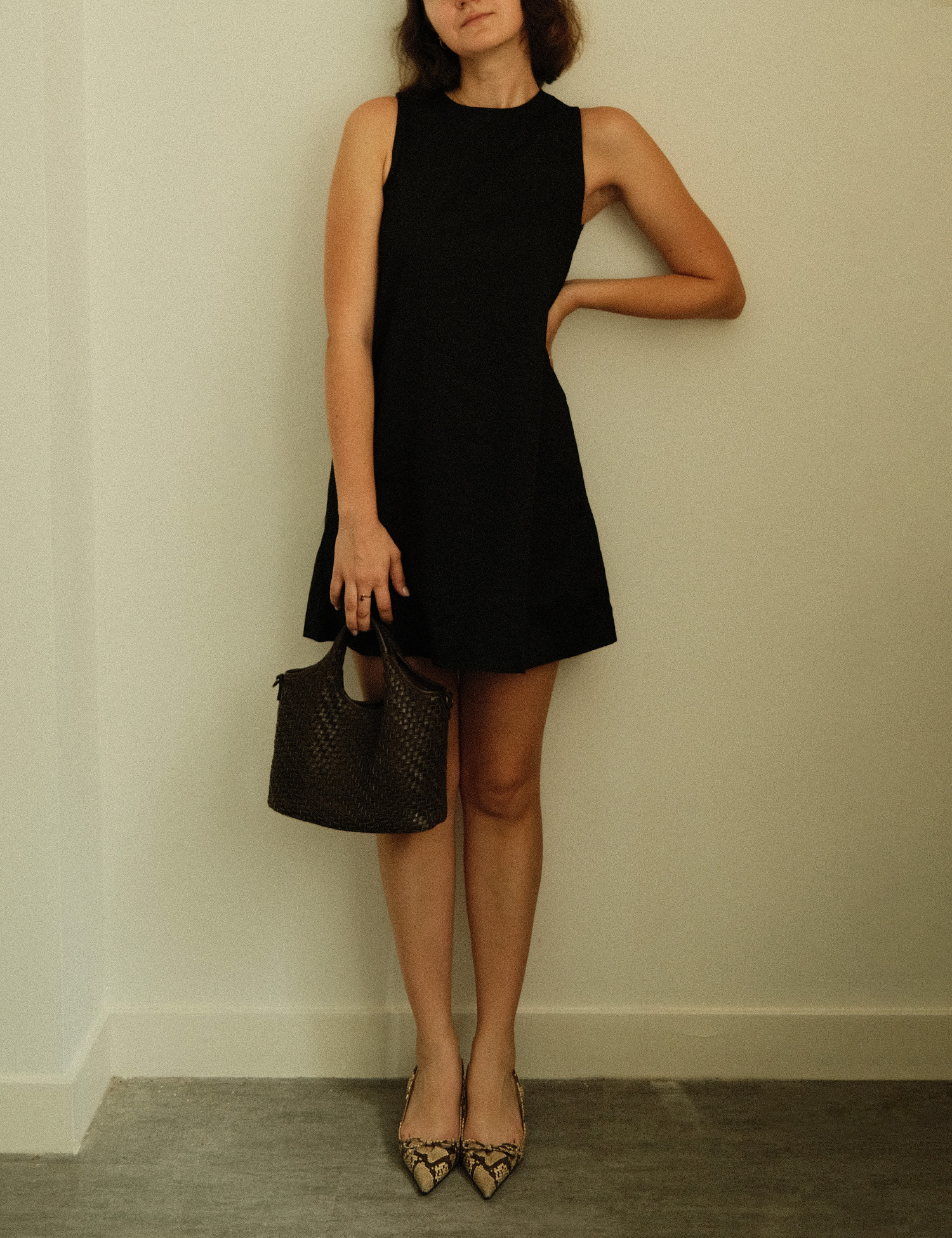
Front view of the Mona Dress, styled with statement shoes for dressier occasions.
There was no easier place to start solving for the noted gaps in my closet than with the black dress. I pulled some midweight black cotton twill from my fabric collection and got cutting after planning three simple modifications. My first change was to exclude the pockets because controversially, I prefer my dresses pocketless. The next modification was to shorten the length of the dress. I stand at about 5ft 5in (165cm) and noticed the dress would be longer than I prefer. To do this, I measured from my high point shoulder to where I would want the hem to sit, then transferred it onto the paper pattern. The third and final modification was the hem construction itself. Instead of the instructed 7/8” (2.2cm) rolled hem, I increased the hem width to 1.5” (3.8cm), ran the raw edge through my overlocker, and then topstitched it down.
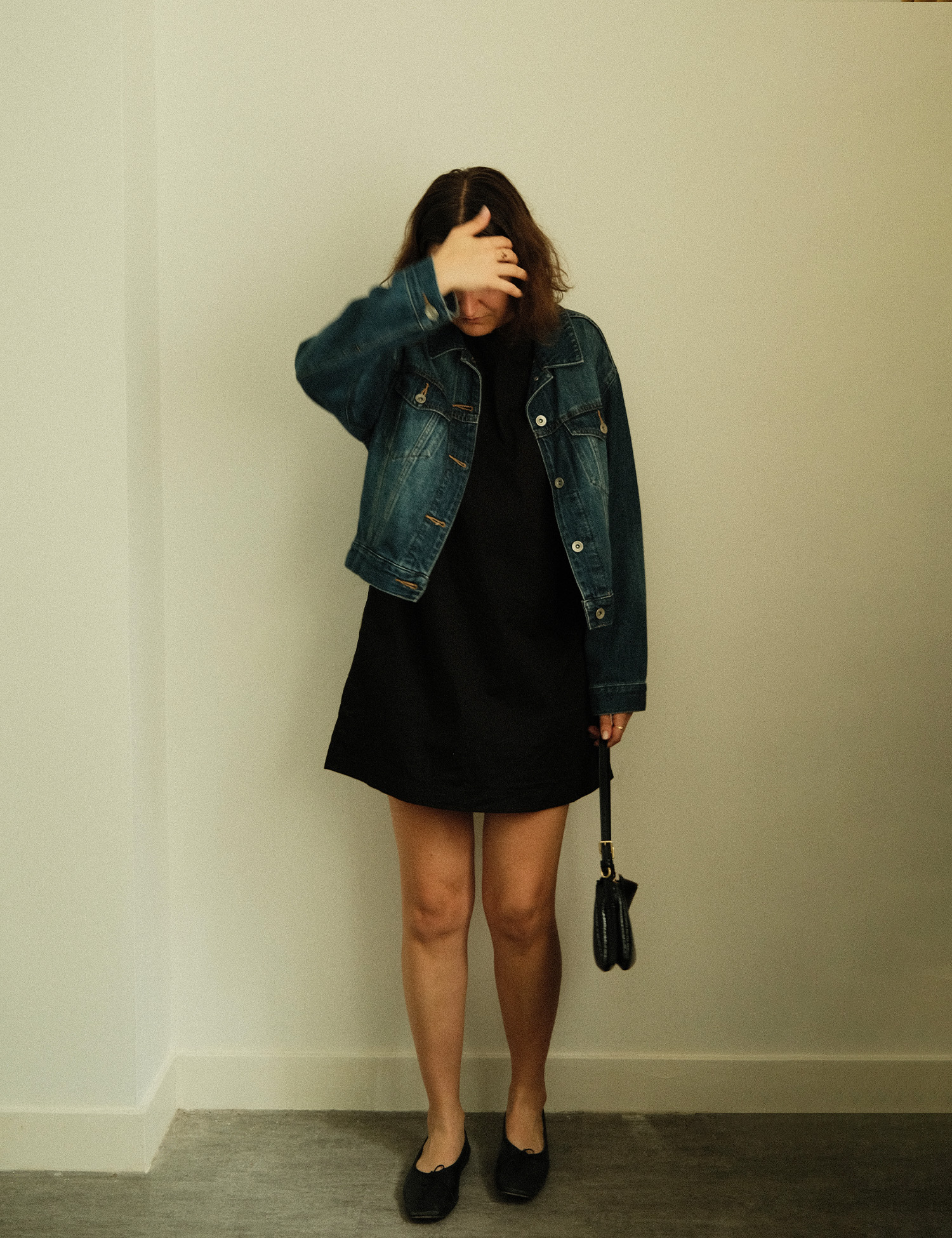
Mona Dress styles easily with flats and a light denim jacket for transitional weather.
Whenever I pull on a Little Black Dress, I am instantly reminded why they have the reputation they do. A simple and well executed garment in a color as elemental as black really can go the distance. Whether styled casually with flats and a light jacket, a simple sandal or funky pair of trainers, or even dressed up with a statement heel and coordinating handbag, it’s a true blank slate that can’t help but read “put together.”
With my new Little Black Dress doubling as a wearable sample confirmed a success, I was ready to start a cocktail dress version to wear for an event I have later this summer. While I initially was inspired by the lace trim of a Reformation dress I saw on Pinterest, at the fabric store I came across two colorways of a raw silk with embroidery, glass beads, and sequins. Talk about texture! After much debate I decided on burgundy, this way I could style the dress with tights in cooler seasons.
Again, I prepared modifications: removing the pockets, raising the hem even higher than the black dress, and to suit the formal fabrication I decided to hand sew the binding around the armholes and neck, as well as the hem. The fabric’s stiffness accentuates the Mona’s trapeze shape, giving it a 60’s mod attitude. That, along with the beaded embroidery and silk’s surface glistening in the light, made me want to dance around post-final-press-try-on.
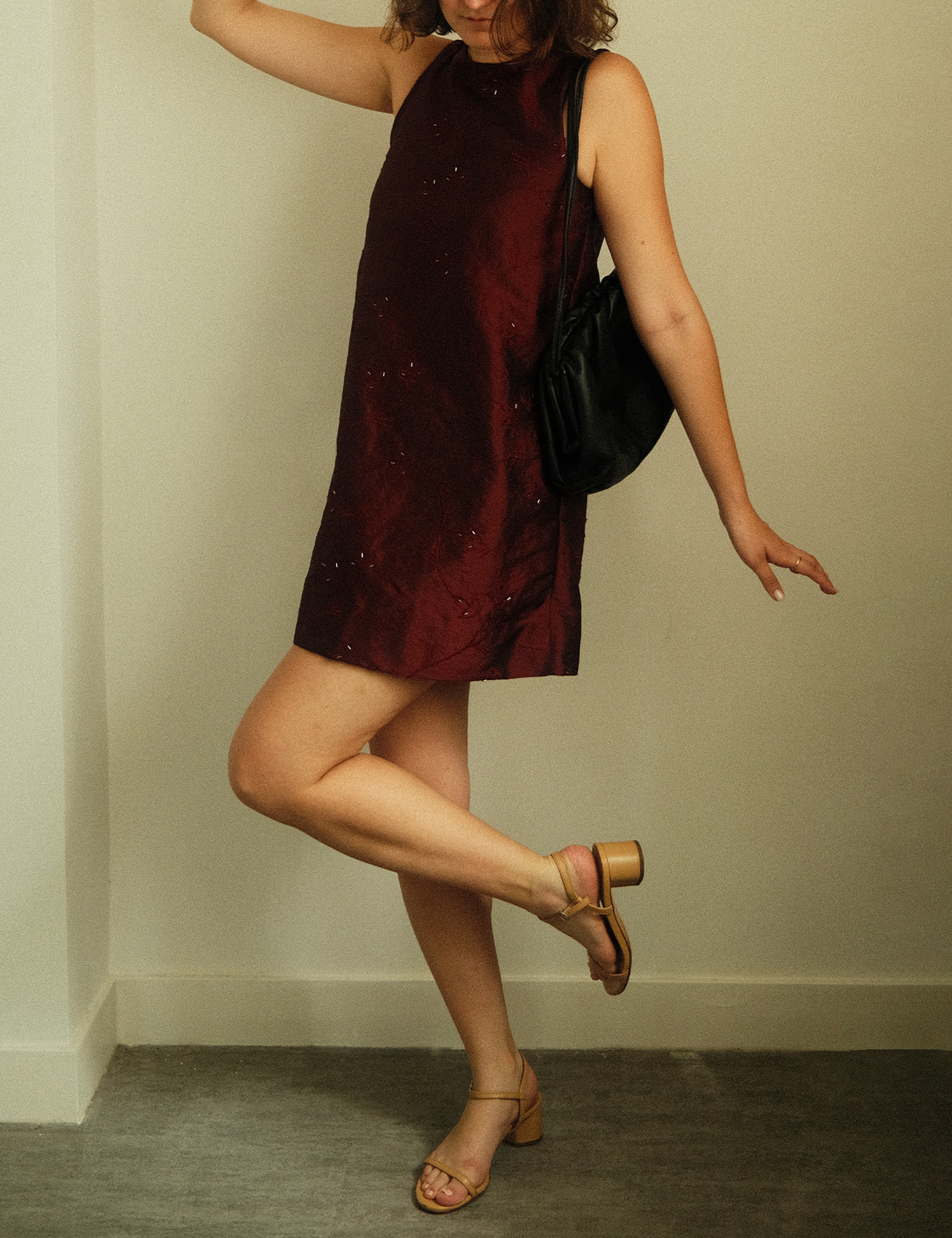
The Mona Dress in a fun and formal fabric makes a great cocktail dress for wedding-guest season.
Now having a textured cocktail dress sorted, it was time to address the third closet gap, a going-out top. The instructions for the Mona Dress are written to finish the neck and armholes with bias binding, but after finding a vibrant turquoise chiffon with woven silver dots, I couldn’t resist the opportunity to make a lined version.
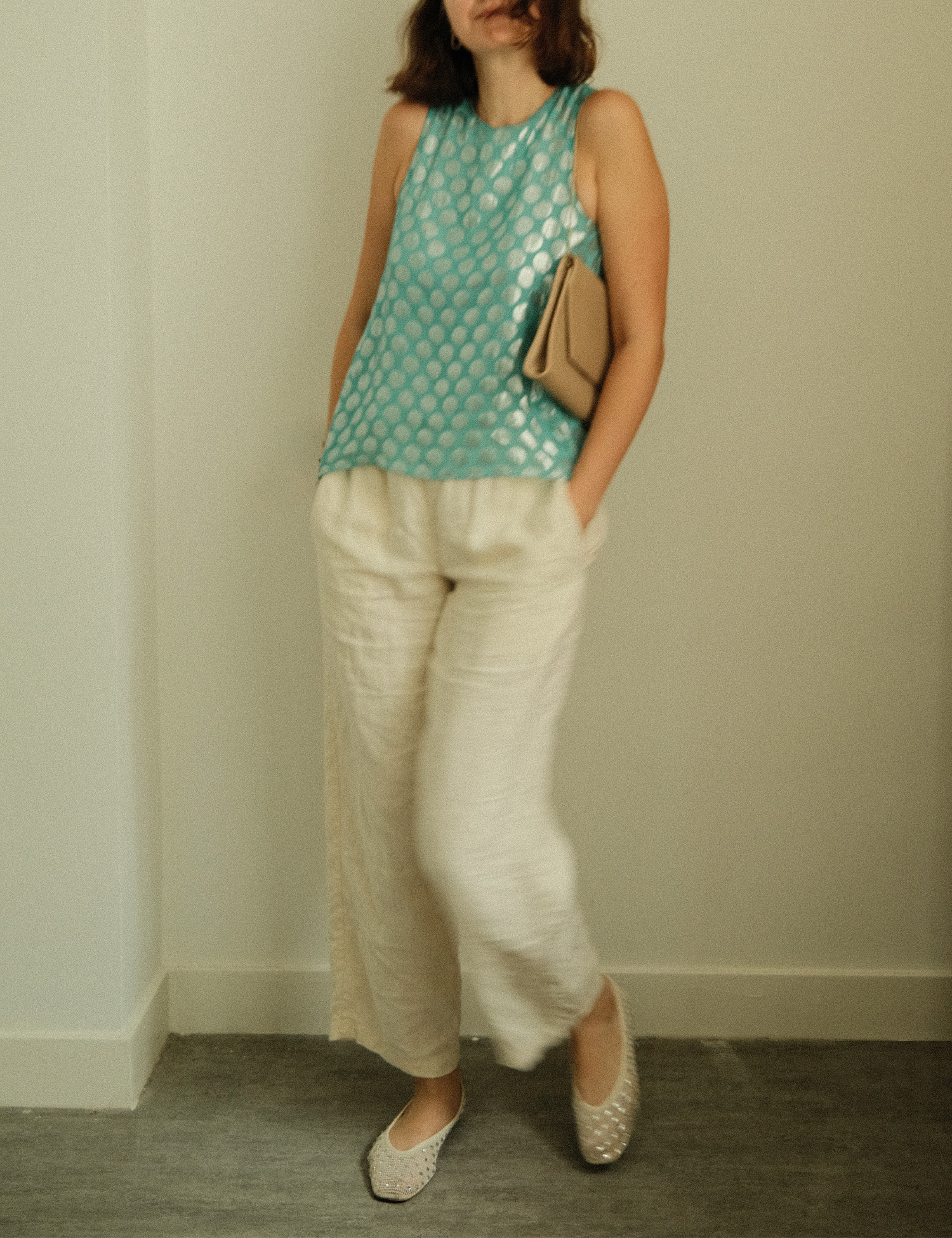
Hacked version of the Mona Dress into a top.
To get the top to sit at the right length, I pulled the black dress over a pair of trousers and pinned where I wanted the hem to fall. I transferred this to the pattern pieces, adding back 7/8” (2.2cm) seam allowance for the rolled hem. At the side seams and shoulders, I added an extra 1/4” (6cm) so I could cleanly finish them with french seams. After cutting the front and back pattern pieces in both main and lining fabrics, I sewed them together using the “burrito” method to self-enclose the raw edges. As a finishing touch and extra layer of stability for the delicate fabrics, I edgestitched around the arm and neck holes. Because of the burrito method, I didn’t need to cut the back keyhole facing piece.
My hacked Mona Dress quickly proved to be the perfect going-out top, making its inaugural appearance at a disco brunch just days after finishing. The fabric’s dressiness stands out in a simple top, and paired with white linen it perfectly embodied the “effortless fun” vibe I go for when dressing up for in the summer. Even better, I found the turquoise top also works with a more serious tone of styling, like with my chocolate Fabrics Store Sara Trousers or tucked into a pair of wide leg trousers.
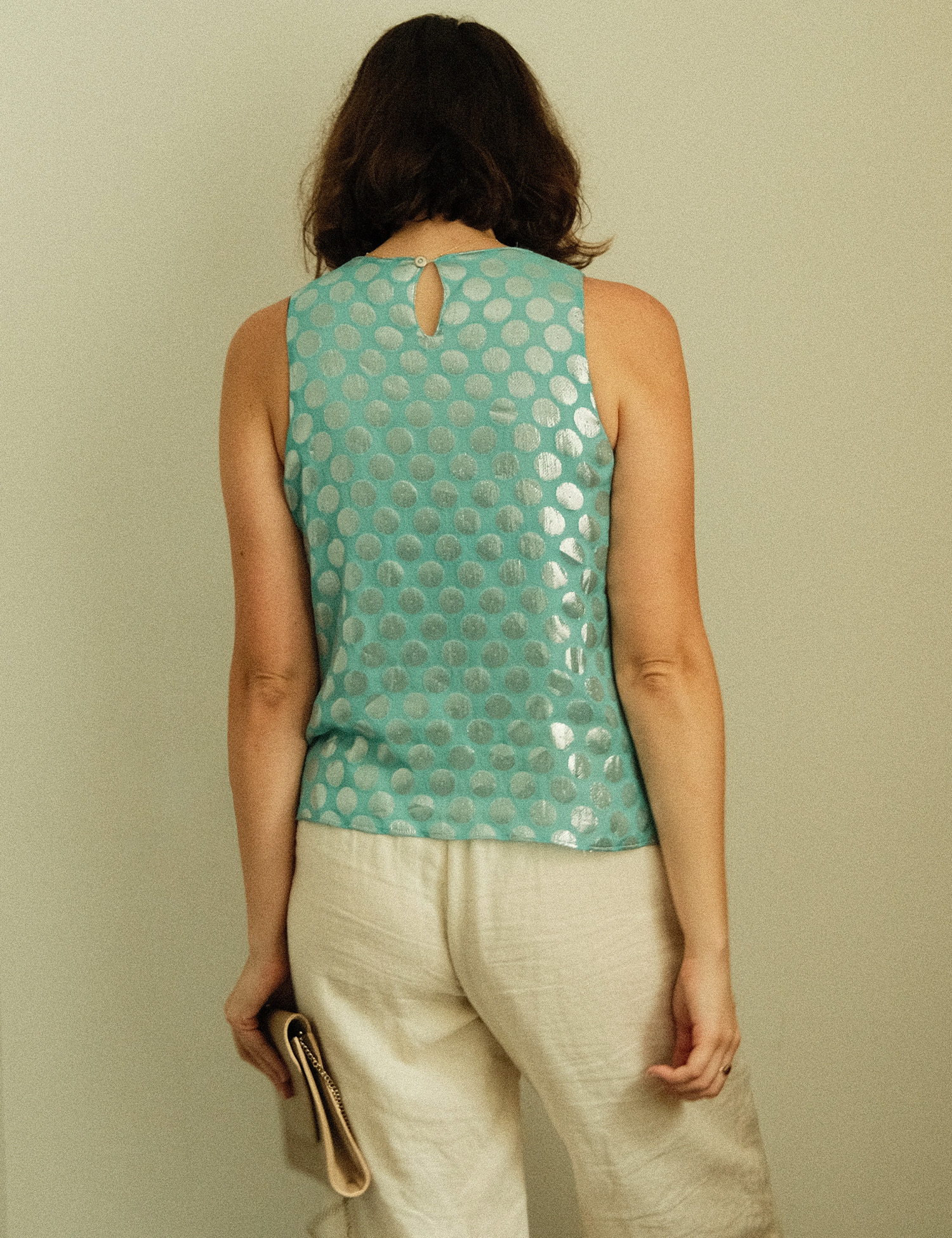
Back view of the hacked Mona Top.
My bust measurement falls between two sizes, but is generally closer to the smaller size so I cut all three versions out as size 4/6. If you are also between sizes and prefer a looser fit around the bust or have a fuller upper bust, I’d recommend sizing up.
The dress sews together quickly, written with a button and bias loop fastening method at the back keyhole. This is the main design detail of the dress after the silhouette itself. Across my three versions I took the opportunity to experiment with slightly different closures. The black twill dress is to pattern, using a bias binding loop and button, the burgundy dress uses a subtle hook and eye, and the turquoise top is sewn with a button and a hand-threaded loop. I could see versions of the closure modified to tie into a cute bow or installed with an exposed zipper.
I was very pleased with how easily the Mona was able to masquerade into different variations of itself. The only notable change between the two dresses was the hem length and yet they give off entirely different personas. And the top is in a league of its own. Emboldened by its simplicity, the Mona Dress is the kind of pattern that can easily adapt to fit a variety of styles – and closet gaps.



2 Comments
Well done! I like the 3 options and the way you style the finished pieces…. Keep sewing!
Love this pattern. Your dresses are beautiful and suit you. I love all your fabric choices. I had a pattern very similar to yours in the 60s and made many of them. It was so quick to cut out and sew up. It had French darts and a keyhole opening at the front. The arm holes were very cut in at the shoulder. I always felt like a million bucks wearing each and every dress. I wish I had the figure and arms to wear one now!
Vancouver Barbara