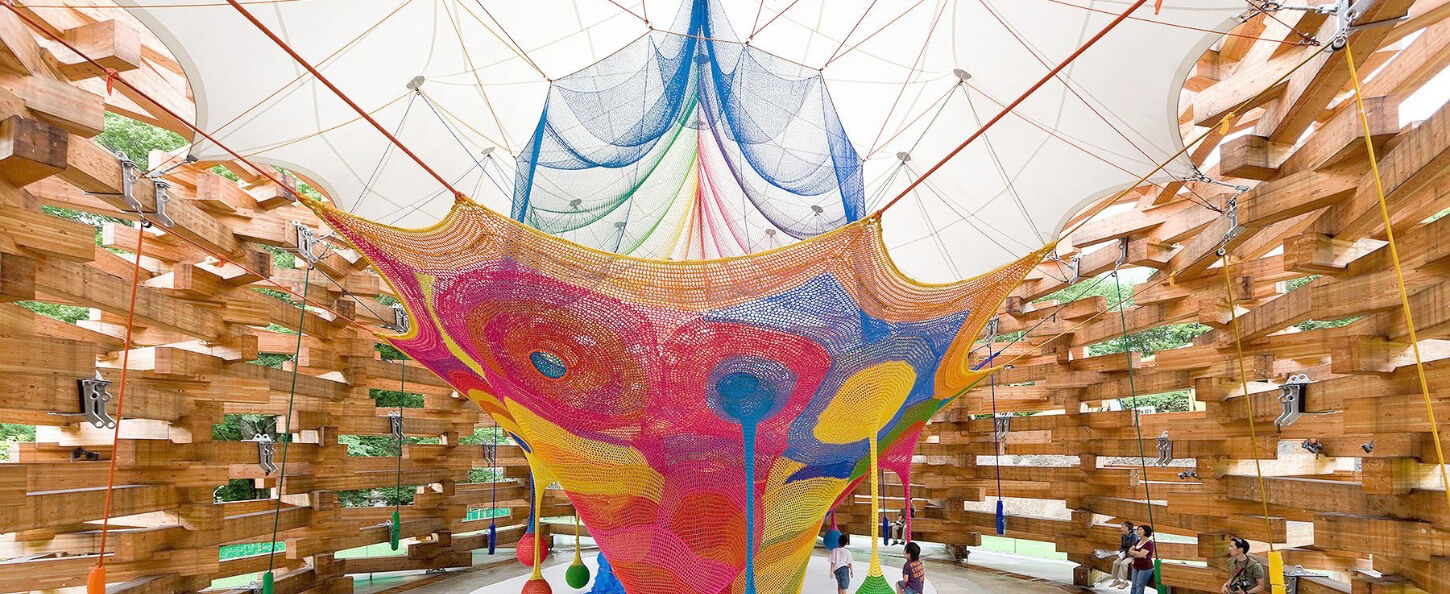
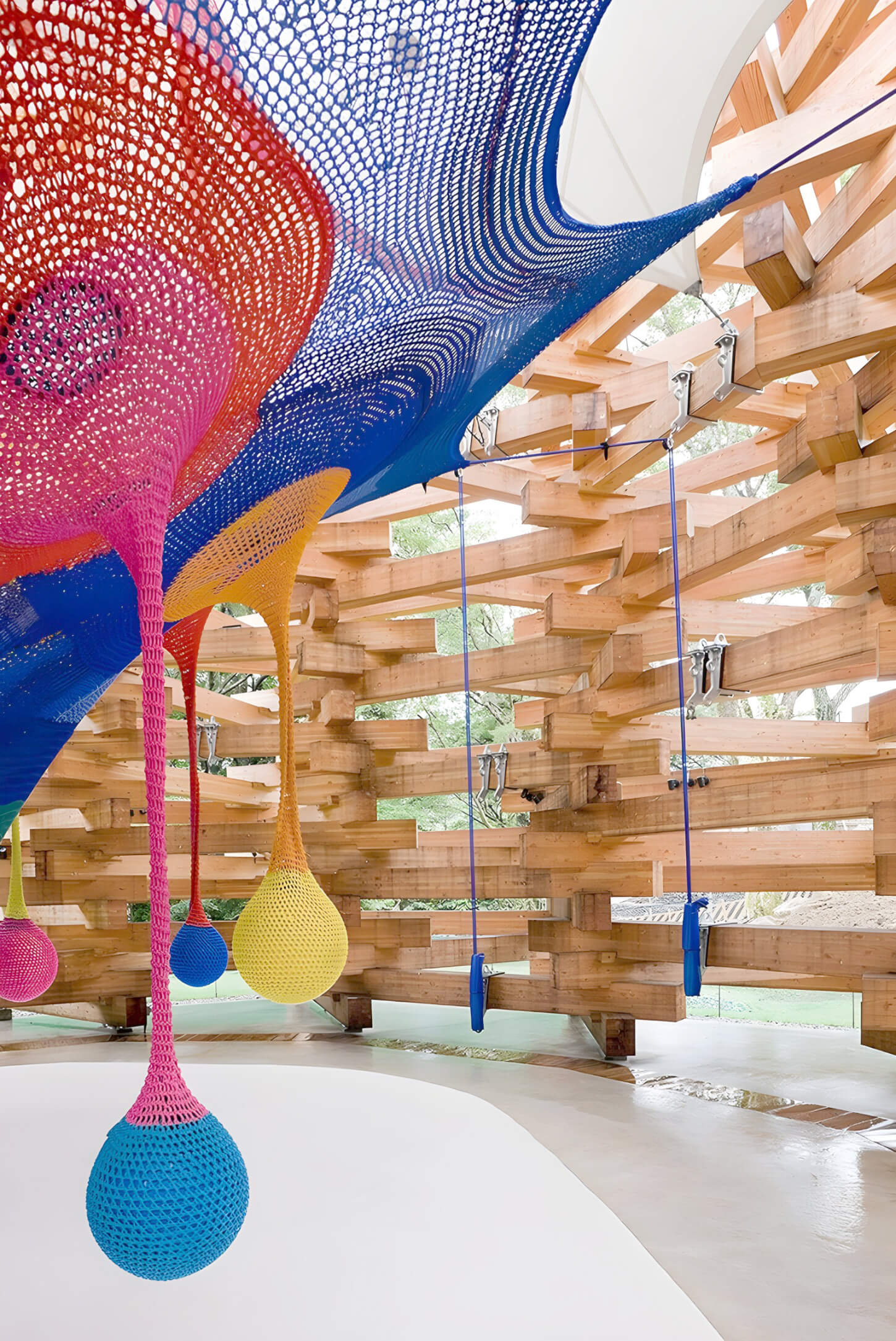
Installation by Toshiko Horiuchi MacAdam in the Woods of Net, Japan
Japanese textile artist Toshiko Horiuchi-MacAdam makes vast, all-encompassing installations, using colourful, crocheted threads to make art with a powerful social purpose – to create free, interactive spaces for children to play, explore, and feed their imaginations. She says, “We need to create spaces for children to play with each other. Children learn through play, grow emotionally and imaginatively; they develop social skills, learn to cooperate, and gain wisdom about life. It is essential they use their bodies, challenge themselves, have fun, sweat and laugh with others.”
MacAdam was born in Japan in 1940. She studied at the Tama Fine Art Institute in Japan, which was a formative period in her artistic career, when some key influences shaped her interest in fusing art and architecture, particularly the work of architect Antonio Gaudi. She remembers back, “When I was a student at Tama Fine Art University in Tokyo, we were introduced to the work of Antonio Gaudi by a professor of architecture. Eventually, in my late 20’s, I travelled to Europe and the Middle East. Of course, I went to Spain to see Gaudi’s work. I also travelled to Isfahan in Iran in particular to look at mosques. Both impressed me a great deal. Antonio Gaudi’s work, as you know, is based on studies of ‘naturally’ curved forms (catenaries) as determined by gravity, turned upside down.”
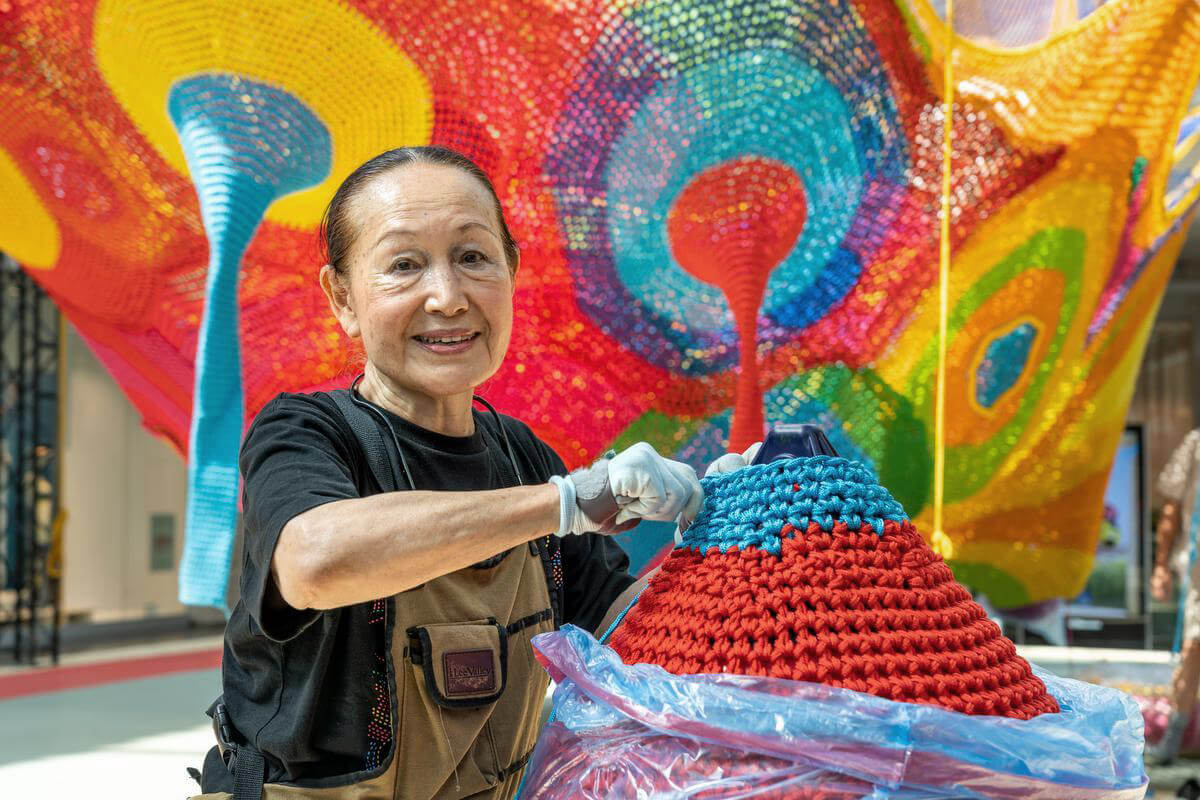
From here, MacAdam went on to study a master of fine arts at the Cranbrook Academy of Art in Michigan. She found work as a textile designer for Boris Kroll Fabrics in New York, before leaving to pursue teaching work in arts institutions throughout the United States and Japan. During the 1970s, MacAdam began making ambitiously-scaled crocheted work in pale, ethereal colour schemes which resembled architectural shapes and forms, including classical columns and Romanesque Church interiors.
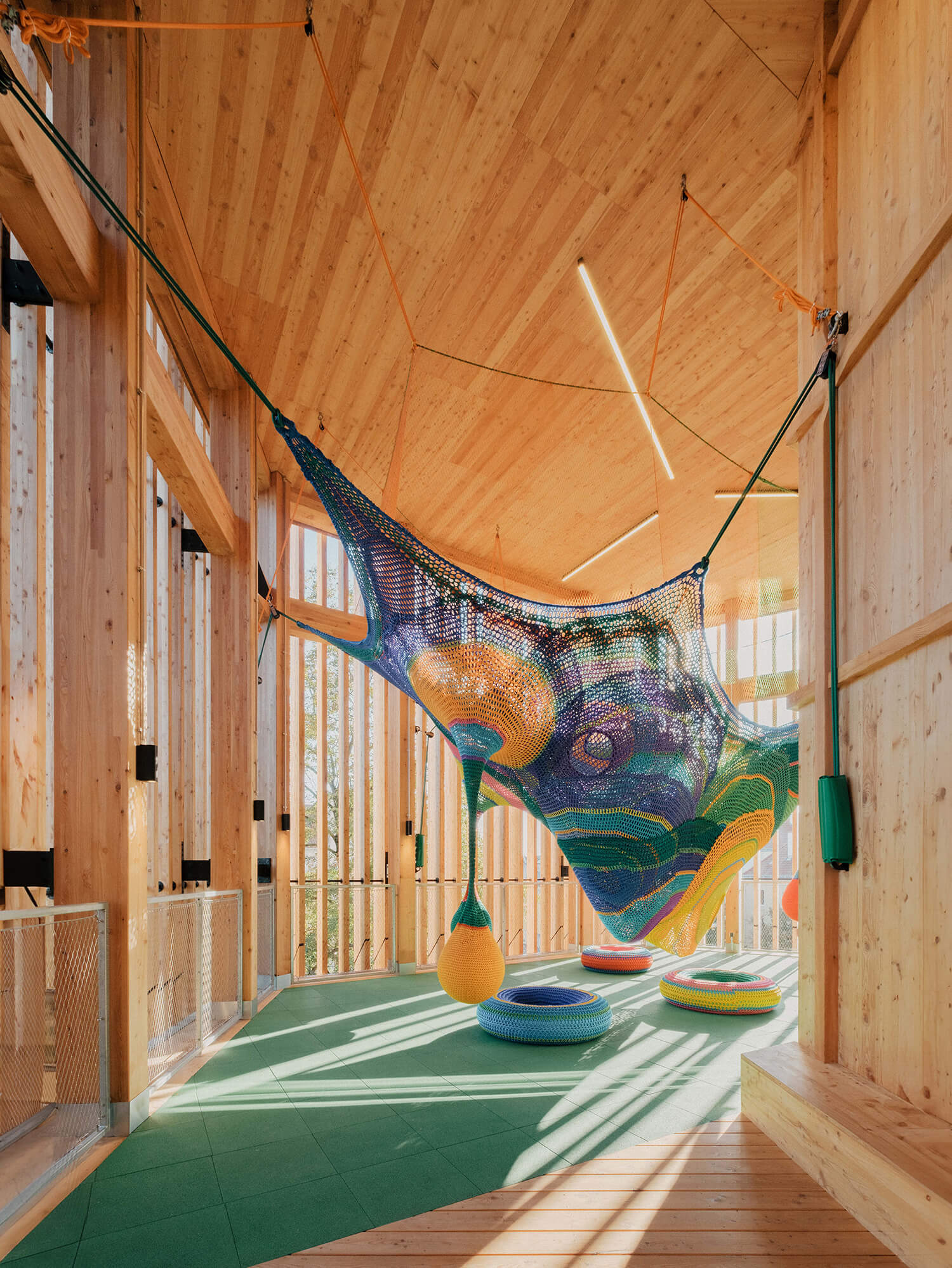
KinderKunstLabor in St. Pölten ?utdoorlab with an installation from Toshiko Horiuchi MacAdam
After witnessing children climbing in one of her artworks, however, she realised her art could play a pivotal role in the lives of young people, particularly in Tokyo, where there is limited access to playground or outdoor space. She says, “One day I was exhibiting a 3-dimensional open-work textile sculpture I had created in collaboration with a friend. Some children came to the gallery and climbed into it. Suddenly the piece came to life. My eyes were opened. I realized I wanted just such a connection between my work and people alive at this moment in time (not a hundred years from now). I realized I was in fact making works for children. It was an exciting moment for me.”

The first work she made with children in mind was donated to a kindergarten in Tokyo, featuring woven nylon threads in vivid, rainbow colours to appeal to children’s senses. She went on to create a playground space for the Hakone Open-Air Museum in Kanagawa, followed by a series of further leisure spaces across Japan. Making these net-like structures by hand is a labour-intensive process, which involves a team of skilled makers, and sometimes elements of machinery, as MacAdam explains, “My works are mostly made by hand, but in certain pieces (our ‘SpaceNet’ play environments, for example, as well as ‘Luminous’ a theatrical stage curtain – I have incorporated a mechanically knotted net). However, it begins from my hands.”
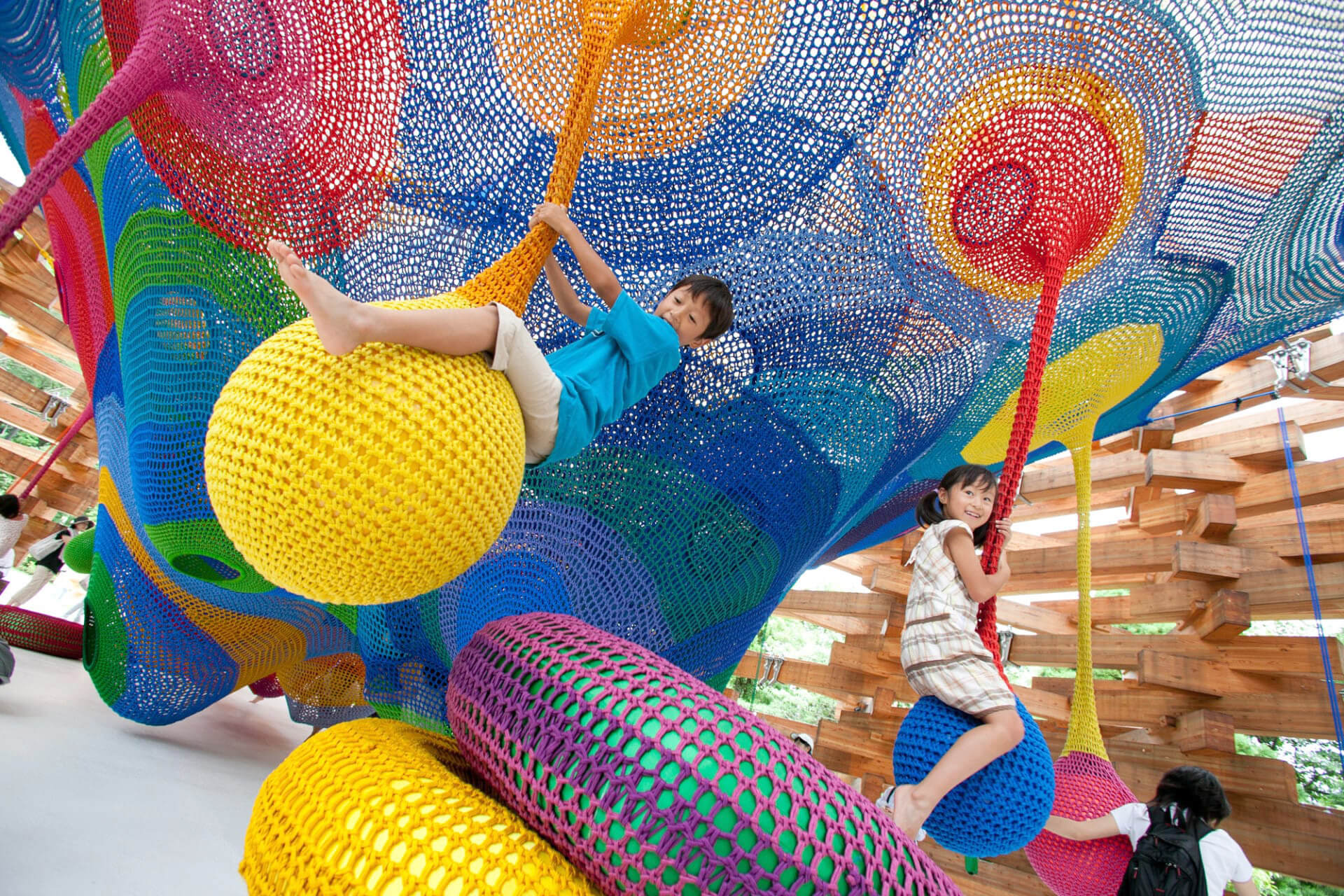
Building on the great success of her crocheted, social structures, MacAdam has gone on to found a business with her husband called Interplay Design and Manufacturing in Bridgetown, Nova Scotia, a platform for creating ‘play’ sculptures across the globe, aimed at encouraging children from all walks of life to access free, open-air spaces where they can let their growing imaginations run wild.